ElevenLabs has become the name most people mean when they say “AI voice generator,” powering everything from audiobook narration to YouTube voiceovers to conversational AI phone agents. The company’s own homepage focuses on the wins, but the pricing, the limitations, and the genuine ethical questions around voice cloning rarely get the same attention. This guide covers what using ElevenLabs is actually like in 2026, based on the current product lineup, so you know exactly what you are signing up for.
Table of Contents
What Is ElevenLabs?
ElevenLabs is an AI audio company best known for text-to-speech generation, voice cloning, and increasingly, full conversational voice agents for businesses. Founded in 2022 by Piotr Dabkowski and Mati Staniszewski, the company built its early reputation on producing speech that sounded noticeably more natural than the robotic text-to-speech tools most people had used before, and it has since expanded into a much broader audio platform, a trajectory covered in more depth on the company’s own about page.
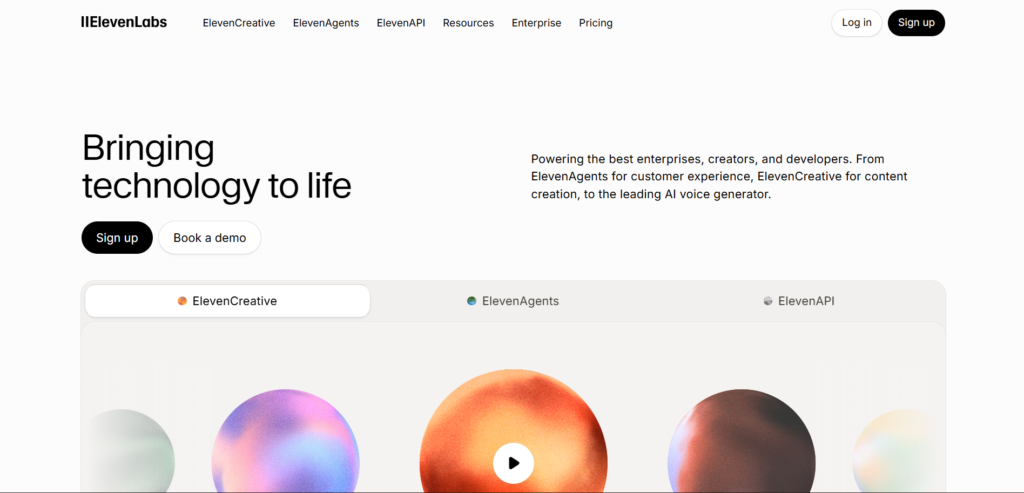
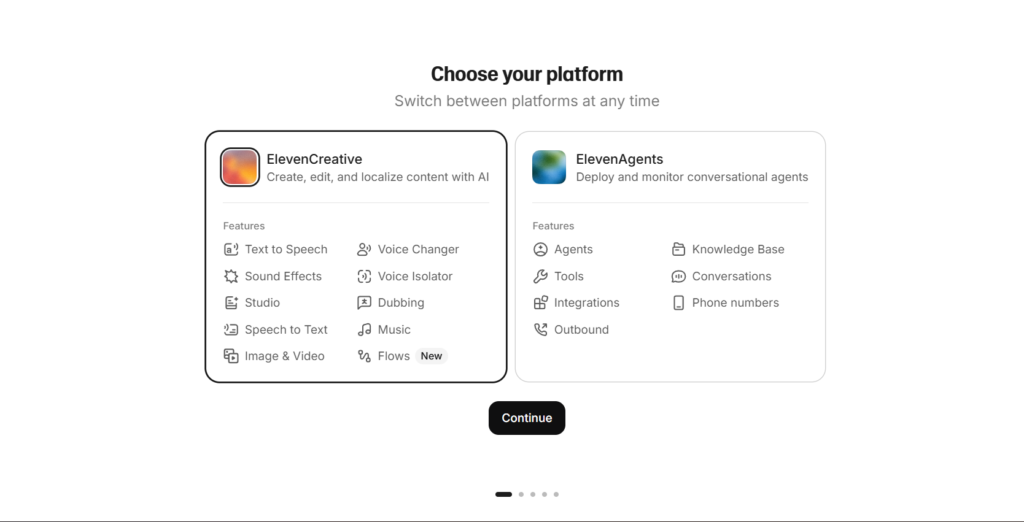
The product now spans three distinct areas that Anthropic-style pillar reviews often lump together but are worth separating clearly. ElevenCreative covers text-to-speech, voice design, and the dubbing studio, aimed at creators and content teams. ElevenAgents covers conversational AI, the technology behind AI phone agents and voice assistants that can hold a real-time conversation rather than reading a script. ElevenAPI is the developer layer underneath both, letting companies build ElevenLabs’ voice technology directly into their own products.
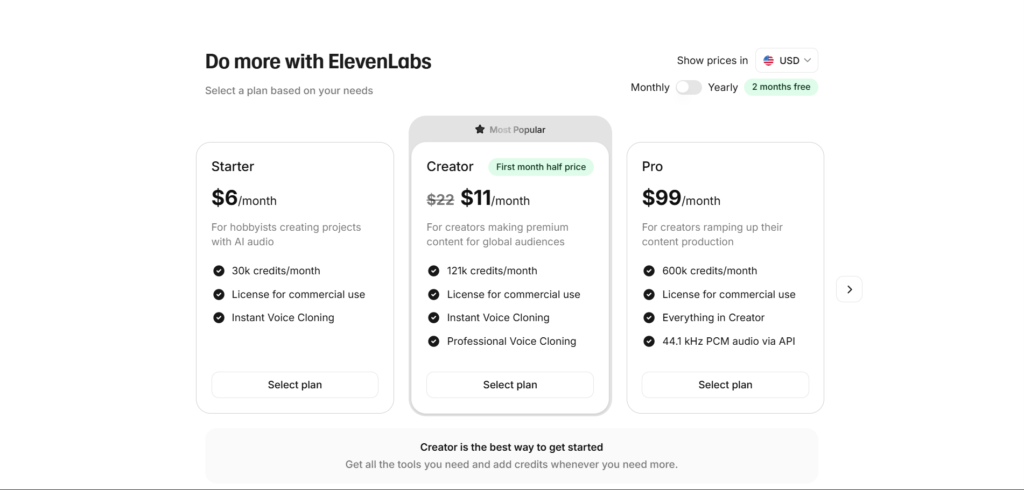
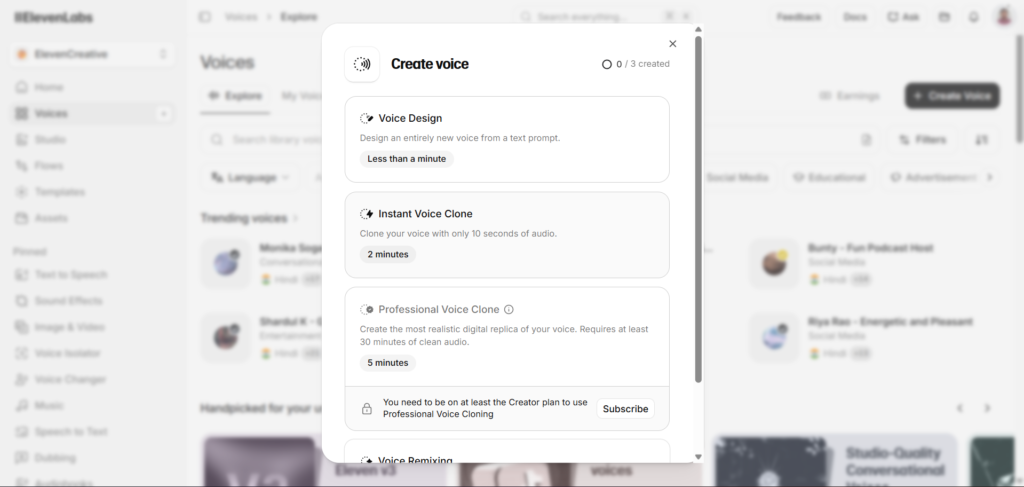
At the center of all three is voice cloning, split into two tiers of sophistication. Instant Voice Cloning creates a usable clone from a short audio sample in under a minute, available starting on the Starter plan. Professional Voice Cloning, unlocked on the Creator plan and above, uses longer, more carefully recorded samples to produce what the company calls a hyper-realistic digital twin of a voice, closer to indistinguishable from the original speaker in casual listening tests.
From Single Tool to Full Platform
It is worth noting how quickly ElevenLabs moved from being a single-purpose tool to a genuine platform. Early adopters mostly used it for one thing, generating narration for videos or audiobooks. The current product spans real-time conversational agents handling live phone calls, a full dubbing studio for multilingual video localization, and a developer API powering voice features inside completely unrelated third-party products. This breadth is part of why comparing ElevenLabs directly to a narrower, single-purpose competitor can be misleading without first clarifying which specific product line you actually need.
This capability is genuinely impressive from a technical standpoint, and it is also exactly why ElevenLabs sits at the center of a real, ongoing conversation about consent and misuse. The FTC has been tracking voice cloning scams closely, and its own Voice Cloning Challenge initiative explicitly names both fraudulent impersonation and the appropriation of professional voice artists’ work as serious risks the technology creates. Voice actor unions including SAG-AFTRA have been publicly vocal about protecting members’ rights as AI voice cloning becomes more capable, a topic worth understanding before assuming voice cloning is purely a creative convenience.
If you are specifically weighing ElevenLabs against a music generation tool rather than a voice tool, it is worth understanding why that comparison doesn’t actually hold up the way it seems to on the surface, since the two solve fundamentally different creative problems despite both being audio AI.
How ElevenLabs Works?
At a technical level, ElevenLabs uses a combination of proprietary text-to-speech models and voice cloning architecture trained on large volumes of audio data, producing speech from written text or transforming one voice into another based on a reference sample. The specific mechanics are proprietary, but the practical experience is straightforward: type text or upload a script, select or clone a voice, and generate audio in seconds to minutes depending on length.
Two Model Types for Different Needs
ElevenLabs offers two primary text-to-speech models built for different use cases. The Flash model prioritizes sub-second latency, making it the right choice for real-time voice agents where any delay breaks the illusion of natural conversation. The Multilingual V2 model prioritizes audio quality and supports a significantly longer character limit per generation, making it the better choice for final, polished output like audiobook chapters or finished video voiceovers. A practical workflow many creators use is drafting with Flash for speed, then rendering the final version with Multilingual V2 for quality.
The Credit System
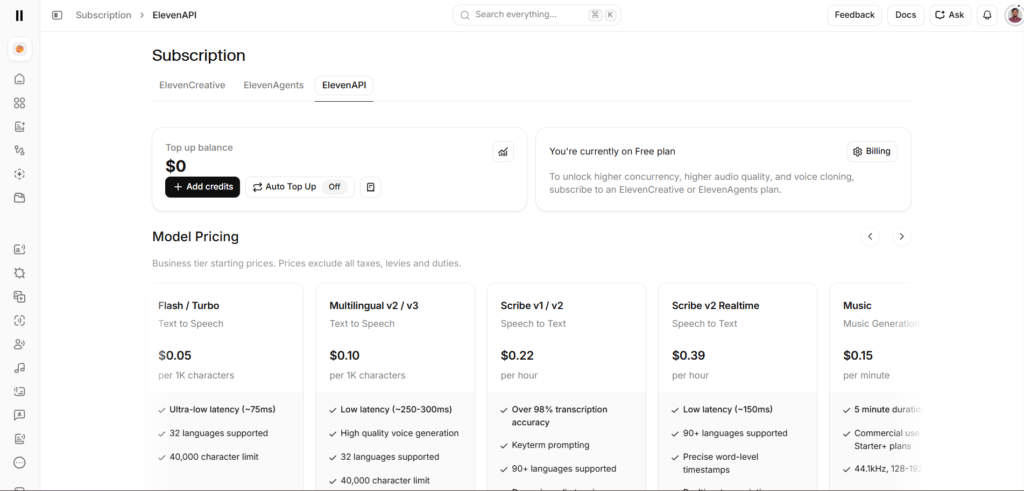
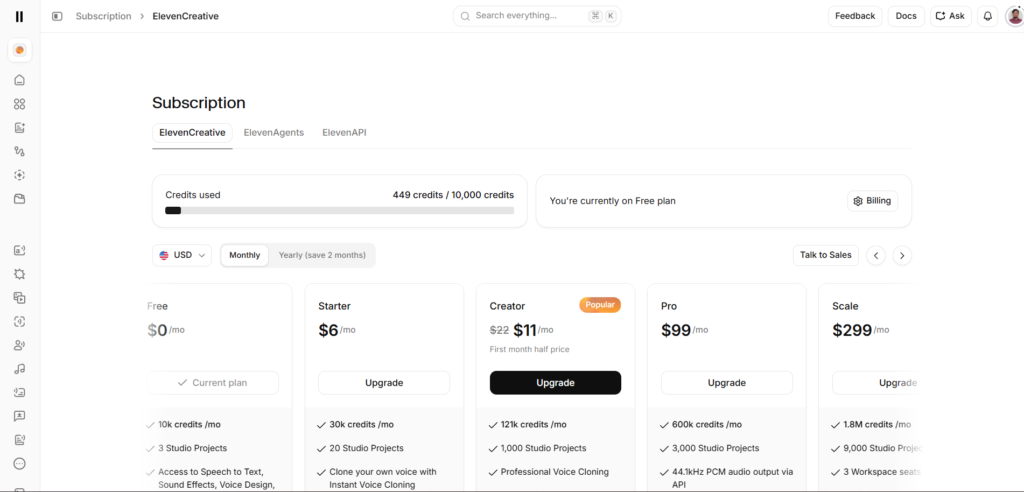
ElevenLabs bills usage through a credit system tied directly to character count, where one credit roughly equals one character of text processed under the standard Multilingual V2 model. This means cost scales with how much text you actually convert to speech rather than a flat per-generation fee, which matters significantly for anyone planning to use it for long-form content like full audiobooks. The official ElevenLabs pricing page lists current credit allowances per tier, though the full mechanics of how these credits actually work across each pricing tier matter more than the headline monthly price, since two people paying the same subscription can have very different real usage capacity depending on which model they use.
Voice Cloning Mechanics
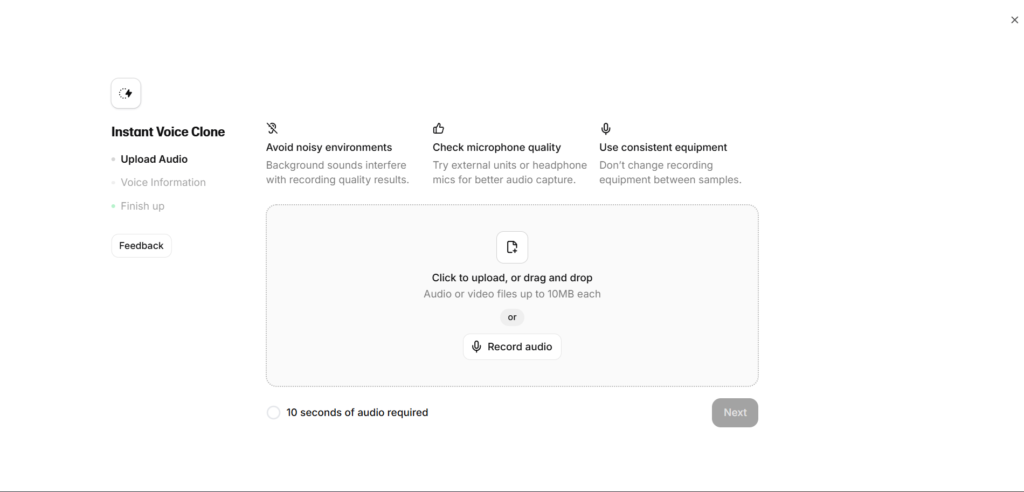
Instant Voice Cloning works from a relatively short sample, often just a minute or two of clean audio, and produces a usable clone quickly, though with some detectable artifacts if you listen carefully. Professional Voice Cloning requires a longer, higher quality recording session, sometimes with guided prompts, and produces meaningfully more convincing results, a distinction the company details on its own voice cloning product page. Anthropic’s own research into AI safety broadly, and Anthropic’s approach to responsible AI development, offers a useful comparison point for how differently companies in the AI space are choosing to handle consent and misuse safeguards around powerful generative capabilities like this one.
Conversational AI Agents
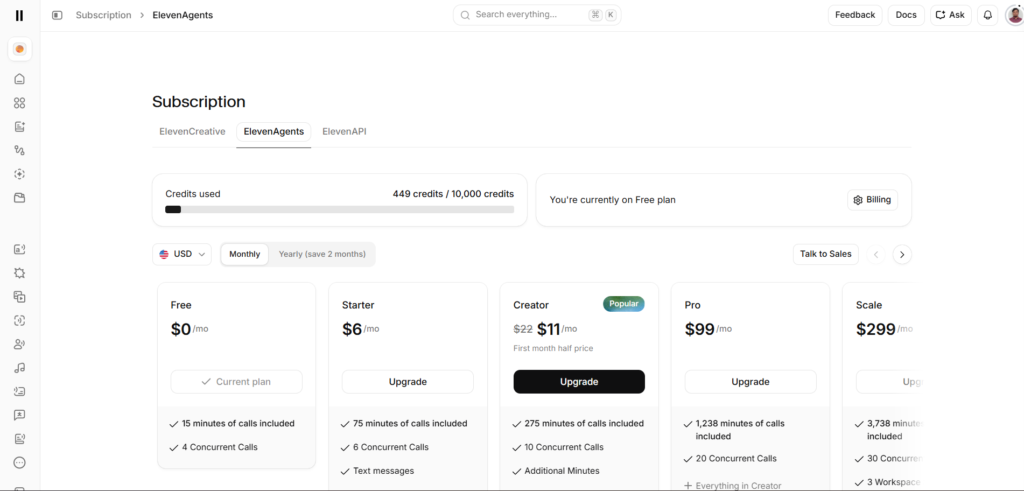
ElevenAgents extends the core voice technology into full, real-time conversational agents that can handle phone calls, answer questions using a connected knowledge base, and follow structured workflows. This is a meaningfully more complex product than text-to-speech alone, since it requires low latency, natural conversational turn-taking, and integration with a business’s existing systems, which is why this specific product line has its own set of considerations worth exploring separately from the simpler creative use cases most people first encounter.
Step-by-Step Guide to Using ElevenLabs
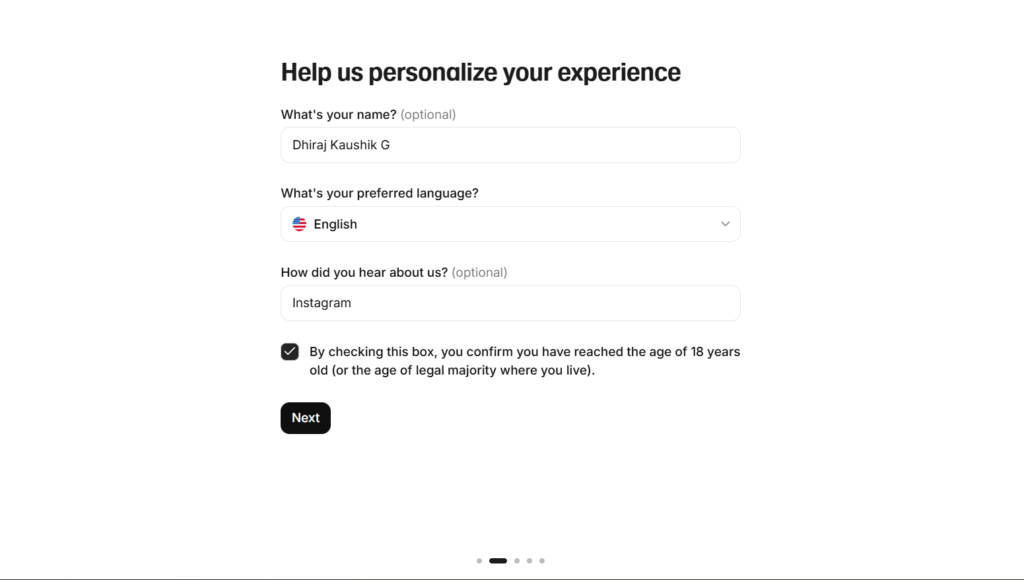
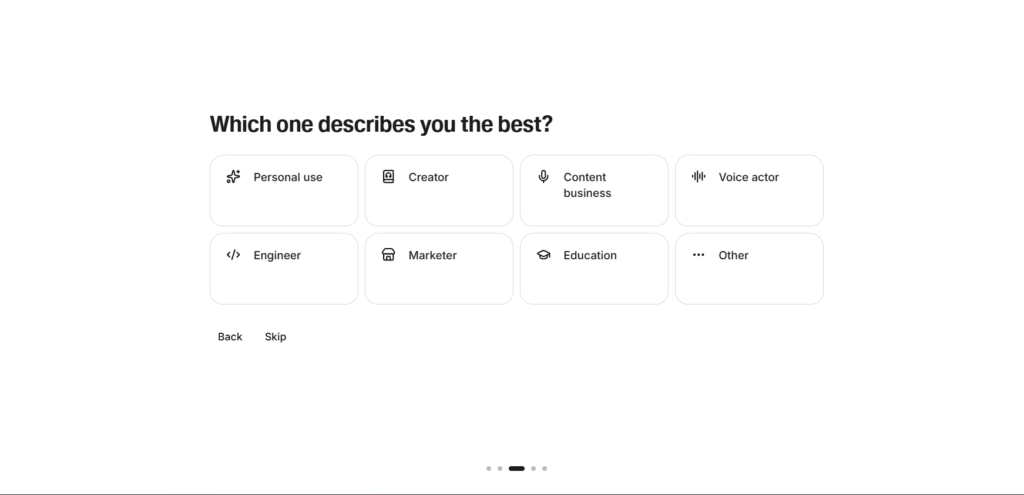
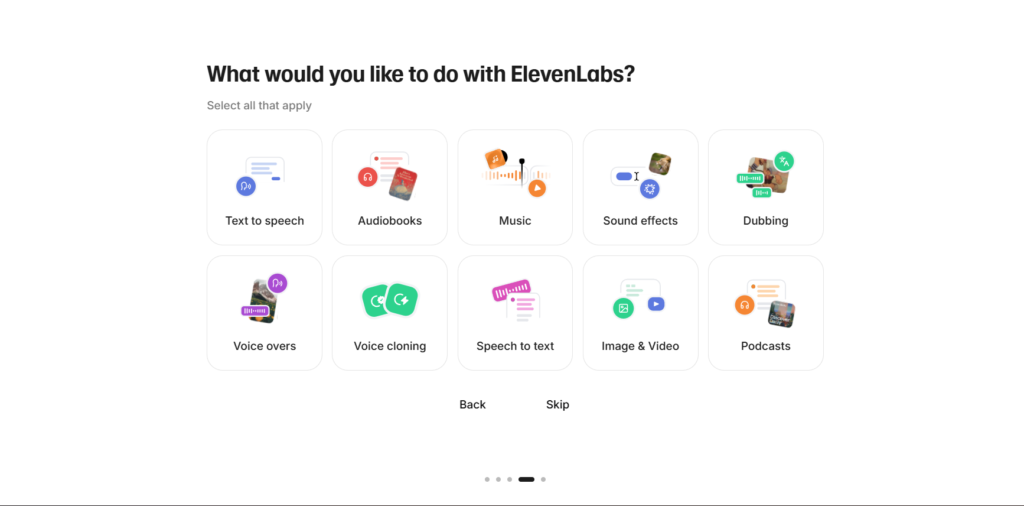
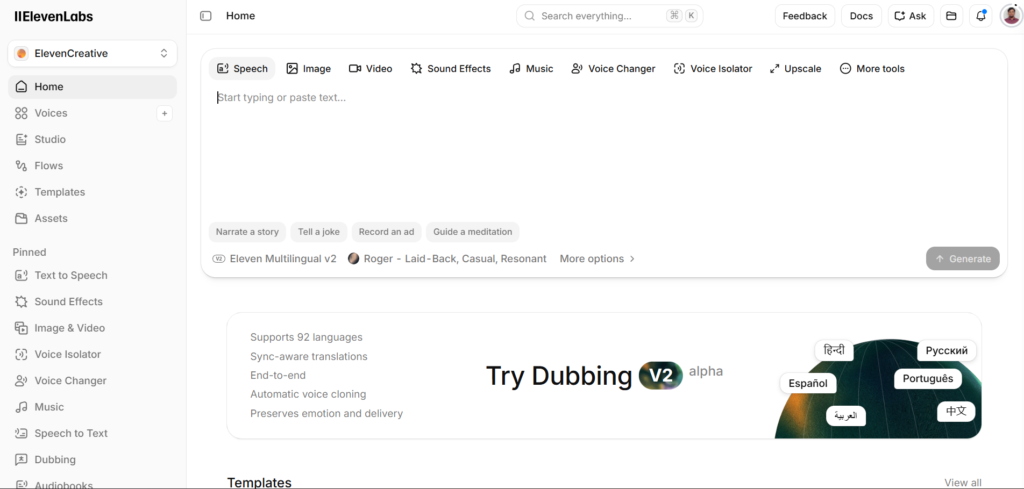
Getting started with ElevenLabs takes a few minutes. Here is exactly how to go from signup to your first generated audio.
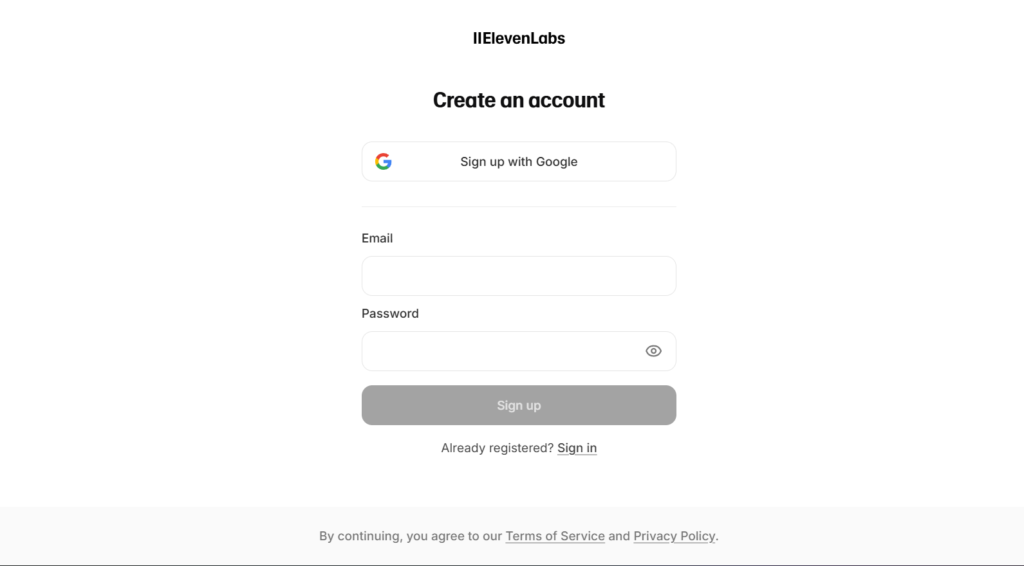
Step 1: Create Your Free Account
Sign up at elevenlabs.io using your email address. The free plan includes 10,000 credits monthly, roughly ten minutes of high quality text-to-speech, enough to properly test voice quality before committing to a paid plan.
Step 2: Explore the Voice Library First
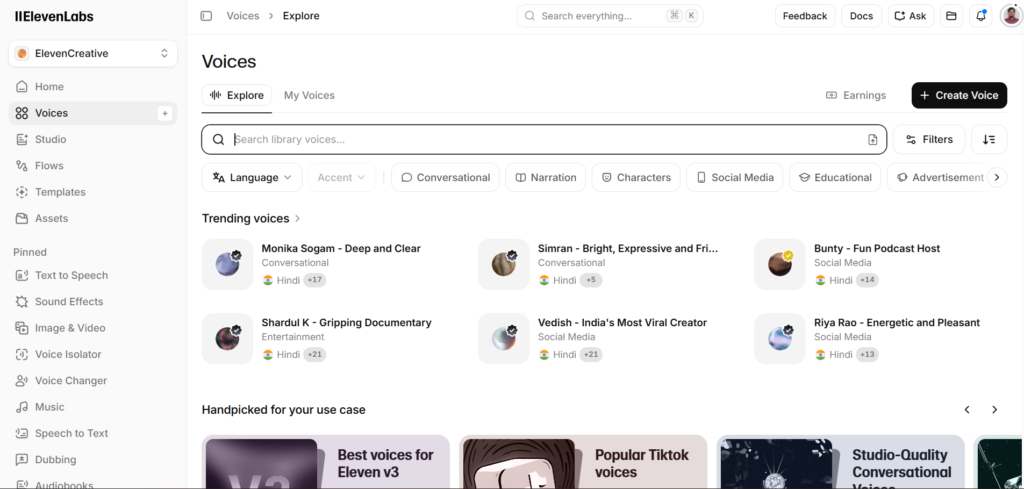
Before generating anything, browse the built-in voice library to hear the range of available voices across accents, tones, and languages. This gives you a realistic sense of quality before testing your own script.
Step 3: Generate Your First Text-to-Speech Sample
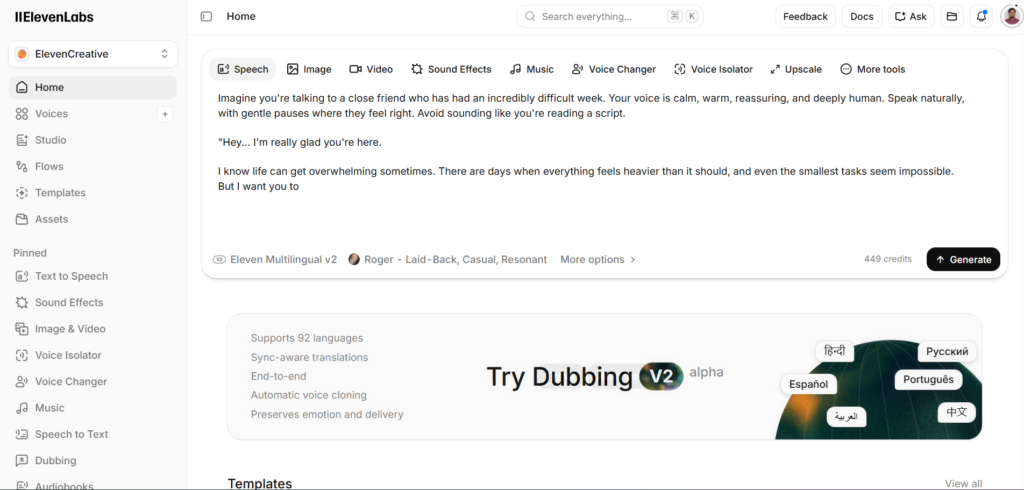
Paste a short script into the Speech Synthesis tool, select a voice, and generate your first sample. Compare the Flash and Multilingual V2 models on the same text to hear the practical difference in quality and speed for yourself.
Step 4: Understand the Commercial Use Restriction on Free
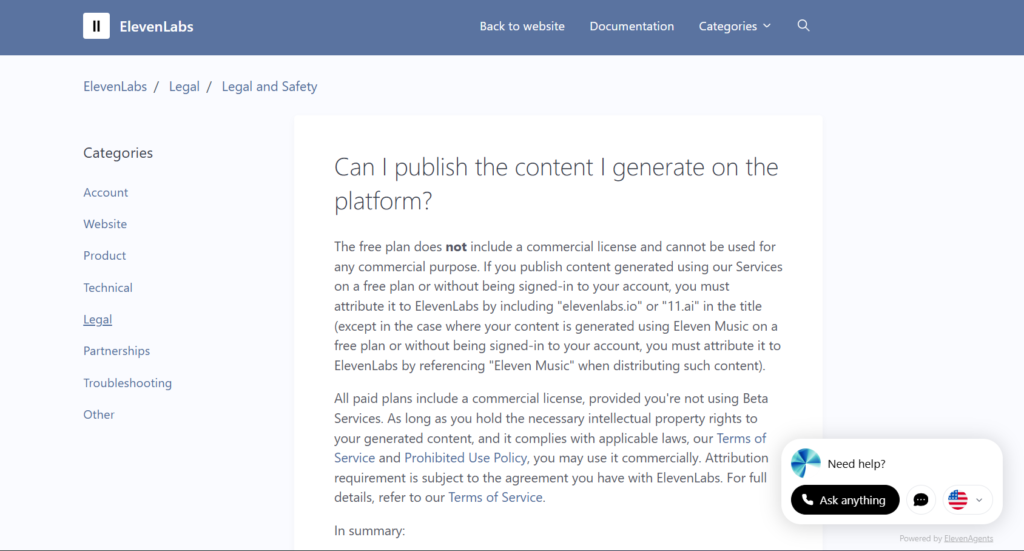
The free plan does not include commercial usage rights, and generated audio requires attribution to ElevenLabs. If you plan to publish anything commercially, even a monetized YouTube video, you will need at least the Starter plan before using free-tier audio in that context.
Step 5: Try Instant Voice Cloning If Relevant to Your Work
If you need a consistent voice across a project, Starter plan and above unlocks Instant Voice Cloning from a short sample. Upload a clean, minute-long recording and generate your first cloned sample to judge quality against your actual needs.
Step 6: Explore the Dubbing Studio for Multilingual Content
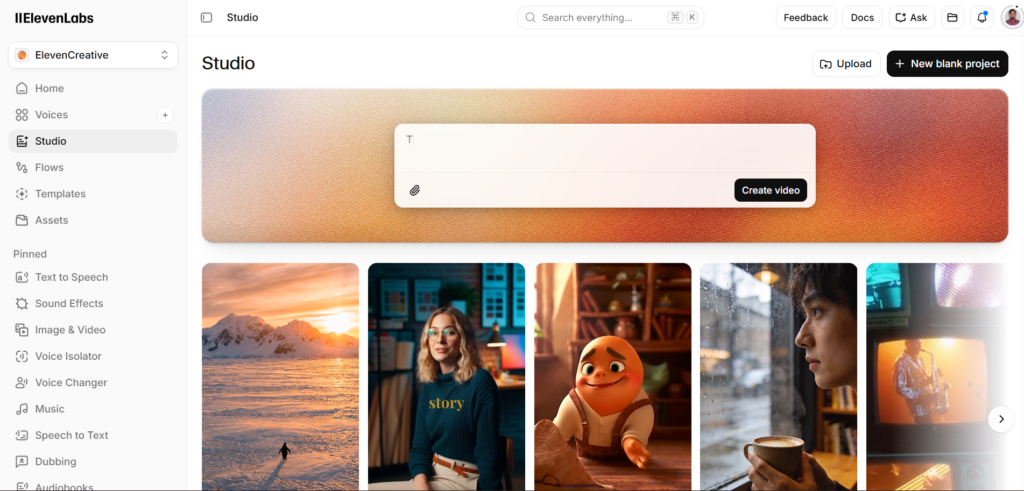
If your work involves translating video or audio content into other languages, the Dubbing Studio, available on paid plans, automates much of what would otherwise require a full localization team.
Step 7: Consider the API Only Once You Have a Real Workflow
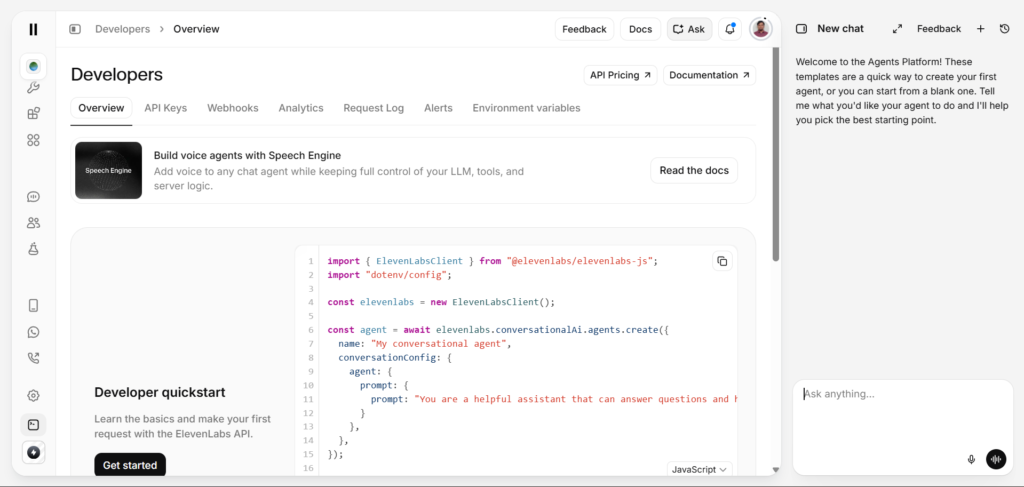
Developers integrating ElevenLabs into a product should hold off on the API until they have validated voice quality and cost per character through the standard web interface first, since API pricing follows a related but distinct structure worth understanding on its own before committing engineering time.
Key Benefits of ElevenLabs
Audio quality remains ElevenLabs’ clearest advantage over older text-to-speech tools, with natural pacing, emotional inflection, and pronunciation handling that noticeably outperforms the robotic output most people associate with computer generated voices. For anyone producing content meant to be listened to rather than skimmed, this quality gap directly affects audience retention.
The two-model system genuinely solves a real workflow problem rather than existing purely as a marketing distinction. Being able to draft quickly with Flash and then render a final, higher fidelity version with Multilingual V2 saves meaningful iteration time compared to a single, one-size-fits-all model that forces every draft through the same slower, higher cost generation process.
The Dubbing Studio addresses a genuinely underserved need for creators wanting to reach international audiences without hiring a full localization team. Automating a large part of what used to require professional voice actors in each target language meaningfully lowers the barrier to multilingual content, even though this specific feature deserves its own detailed look at how close it actually gets to professional studio quality across different language pairs.
Credit rollover on paid plans, allowing unused credits to carry over for up to two months, gives subscribers more practical flexibility than a strict use-it-or-lose-it monthly allowance, particularly for creators with inconsistent, project-based output rather than a steady, predictable monthly volume.
ElevenLabs’ pace of product development also stands out relative to how young the company still is. Launched in 2022, it has already expanded from a single text-to-speech product into three distinct product lines covering creative tools, conversational agents, and a full developer API, a rate of expansion that reflects genuine sustained investment rather than a single feature launched and then left to stagnate while competitors caught up.
Comparison Table
| Tool Name | Standout Feature | Voice Cloning Quality | Commercial Rights | Monthly Cost |
|---|---|---|---|---|
| ElevenLabs | Dual model system, Flash and Multilingual V2 | Very high, especially Professional tier | Starts at Starter plan | Free, then $5 |
| Murf AI | Studio-style editor for teams | Good, more limited cloning | Starts at entry paid tier | Free, then $29 |
| Play.ht | Ultra-realistic voice API focus | High, API-first | Starts at entry paid tier | Free, then $39 |
| Resemble AI | Real-time voice cloning for developers | High, enterprise-focused | Custom, API-based | Custom pricing |
| Amazon Polly | Deep AWS infrastructure integration | Limited cloning options | Pay-as-you-go, no subscription | Usage-based |
Pricing reflects publicly listed individual plan rates as of mid-2026, consistent with figures reported by industry pricing trackers like Vendr’s software cost benchmarking data. Voice AI pricing structures vary significantly by billing method, character-based, minute-based, or usage-based, so compare based on your actual expected volume rather than the headline monthly number alone.
Who Is ElevenLabs For?
Content creators and YouTubers producing regular voiceover work get significant, direct value from ElevenLabs, particularly once volume makes hiring a voice actor for every video impractical. The specific workflow considerations for creators specifically go well beyond just picking a voice from the library, covering pacing, editing, and how to keep AI narration from sounding flat across a long video.
Developers building voice-enabled products, from customer service bots to accessibility tools, benefit from the API layer’s flexibility, though understanding the full technical documentation and integration patterns before committing engineering resources saves significant rework later in a project.
Audiobook producers and publishers represent a growing use case, where the Multilingual V2 model’s quality and the platform’s ability to maintain a consistent narrator voice across many hours of content addresses a real cost barrier that previously required a professional narrator’s full studio time.
Businesses building phone-based customer service or sales agents are a rapidly growing segment specifically served by ElevenAgents, though this use case comes with meaningfully different technical and cost considerations than the simpler creative tools most individual users first encounter.
Accessibility technology developers represent a smaller but genuinely meaningful use case, building tools that give a voice back to people who have lost the ability to speak due to illness or injury. This application, explicitly highlighted by regulators like the FTC as one of the technology’s clearest benefits alongside its risks, tends to get less attention than the creator-focused use cases but represents some of the most consequential work happening on the platform.
FAQ
Is ElevenLabs free to use?
Yes, ElevenLabs offers a permanent free plan with 10,000 credits monthly, roughly ten minutes of text-to-speech using the Multilingual V2 model, and up to three custom voices. The free plan does not include commercial usage rights, meaning generated audio cannot be used in monetized or commercial content without upgrading to at least the Starter plan. For testing voice quality and exploring the platform before committing financially, the free tier is genuinely useful rather than a stripped down demo.
How much does ElevenLabs cost per month?
ElevenLabs pricing spans from free up to $990 a month across six main tiers. Starter costs around $5 monthly and unlocks commercial rights and Instant Voice Cloning. Creator, the most popular tier, costs $22 monthly and adds Professional Voice Cloning and the Dubbing Studio. Pro costs $99 monthly for developers needing more API headroom, while Scale at $299 and Business at $990 serve progressively higher volume needs, with custom Enterprise pricing available above that for organizations requiring dedicated infrastructure and compliance features. Most individual creators find Creator strikes the right balance between cost and unlocked features for regular, ongoing use.
Is ElevenLabs voice cloning safe and ethical to use?
ElevenLabs requires consent verification for cloning voices that are not your own on most plans, and the company has built moderation systems specifically to prevent unauthorized cloning of public figures. That said, the broader technology carries real documented risks, with the FBI’s 2025 Internet Crime Report tracking AI-assisted fraud, including voice cloning scams, as a formal crime category for the first time, resulting in hundreds of millions of dollars in losses. Anyone using voice cloning commercially should only clone voices they have explicit permission to use, and should stay informed about the platform’s specific consent and moderation policies, which continue to evolve as the technology matures and as regulatory scrutiny increases across the industry.
Can I use ElevenLabs for audiobook narration?
Yes, ElevenLabs is increasingly used for audiobook production, particularly by independent authors and smaller publishers who cannot afford a full professional narration budget. The Multilingual V2 model’s audio quality and ability to maintain consistent character voices across long content make it a genuinely viable option for this specific use case, though most professional publishers still pair AI narration with careful human editing and quality review before final release rather than publishing a raw, unreviewed generation.
Does ElevenLabs offer an API for developers?
Yes, ElevenAPI provides developer access to ElevenLabs’ text-to-speech, voice cloning, and conversational AI capabilities, allowing companies to build these features directly into their own products and applications. API pricing follows a structure related to but distinct from the standard subscription plans, generally based on characters processed or minutes of conversational AI usage. Developers should review the official ElevenLabs API documentation directly before estimating costs for a production integration, since usage patterns vary significantly by application type.
How does ElevenLabs compare to Amazon Polly or Google Cloud Text-to-Speech?
ElevenLabs generally produces noticeably more natural, emotionally expressive speech compared to Amazon Polly or Google Cloud’s text-to-speech offerings, which tend to prioritize reliability and infrastructure integration over cutting-edge voice realism. However, Polly and Google’s tools integrate more deeply into their respective cloud ecosystems and often cost less at very high volume for straightforward, non-creative use cases like automated system announcements. The right choice depends heavily on whether voice quality or existing cloud infrastructure integration matters more for your specific application.
Final Thoughts
ElevenLabs earns its reputation as the current leader in AI voice generation specifically because the audio quality gap between it and older text-to-speech tools remains genuinely noticeable, not just a marketing claim. The dual model system, the Dubbing Studio, and increasingly sophisticated conversational agents all reflect real, useful product development rather than features added purely to justify a higher price tier.
The ethical dimension of voice cloning technology deserves honest acknowledgment rather than being treated as a footnote. The same capability that lets a solo YouTuber sound professionally produced also lowers the barrier for the kind of impersonation fraud that regulators like the FTC have been actively working to address. Using the technology responsibly, cloning only voices you have explicit permission to use, is not just good practice but increasingly a matter of basic legal exposure as regulation catches up to the technology.
None of this should discourage legitimate use. The vast majority of ElevenLabs’ actual usage is genuinely creative and productive, content creators narrating their own scripts, developers building accessibility tools, and businesses translating content for wider audiences. The caution around consent applies specifically to cloning someone else’s voice without their explicit permission, not to the technology as a whole.
Start with the free plan to genuinely judge voice quality against your specific use case, and only move to a paid tier once you know exactly which features, commercial rights, professional cloning, or dubbing, you actually need.