If you are thinking about trying the Leonardo AI free plan, there is one thing worth knowing upfront: it is genuinely more useful than most free tiers in this category, but it comes with specific limitations that will matter a lot depending on how you plan to use it. This article lays out exactly what you get, what you cannot do, and when paying actually makes sense.
Table of Contents
What Does the Leonardo AI Free Plan Actually Include?
The Leonardo AI free plan gives you 150 tokens every day, and those tokens reset every 24 hours. There is no expiry date on the free plan itself. You can use it indefinitely without ever paying, as long as 150 daily tokens cover your needs.
Those tokens give you access to the core image generation models, including Leonardo Phoenix, the platform’s own flagship model. You can generate images, use the AI Canvas for basic editing, and browse the community feed. The platform runs in your browser at app.leonardo.ai, so no installation is needed.
What you do not get on the free plan: private generations, custom LoRA model training, rollover tokens, priority queue access, and the ability to keep your images out of the public community gallery. Those features are behind paid plans, and they matter for specific use cases.
How the Token System Works on the Free Plan?
Tokens are the currency for everything you do on Leonardo AI. Generating an image, editing in the canvas, upscaling, removing a background — each action has a token cost based on how much computing power it requires.
On the free plan, you receive 150 tokens per day. These reset every 24 hours, and unused tokens do not roll over to the next day. If you do not use them on Monday, they are gone when Tuesday’s fresh 150 arrive.
The token cost per image depends on the model, resolution, and settings you choose. A standard 512×512 image on a basic model costs around 5 to 8 tokens, meaning you could generate 20 to 30 images at that resolution before running out. At 1024×1024, which is the more common working resolution, token costs are higher, putting your practical daily output closer to 10 to 18 images. If you turn on additional features like Elements or image guidance, each generation costs more tokens per image, which reduces the daily count further.
The platform shows you the token cost on the generation button before you click, so you are not caught off guard. Checking that number before committing to a high-resolution generation with multiple settings enabled is a habit worth forming.
7 Things You Must Know Before Signing Up
1. Your Images Are Public by Default
This is the most important thing to understand about the Leonardo AI free plan before you sign up. Every image you generate goes into the public community gallery. Other users can see it, browse it, and potentially use it for their own projects as a reference or remix. You cannot turn this off on the free plan. Private generation requires a paid subscription starting at Apprentice ($12 per month).
For personal projects, learning, experimentation, or generating images you plan to publish openly anyway, public generation is a non-issue. For client work, confidential brand concepts, or anything you do not want others to see or use, the free plan is not appropriate.
2. You Can Use Free Plan Images Commercially, But With a Catch
According to Leonardo’s official commercial use policy (updated November 2025), free plan users do receive a license to use generated images for commercial purposes. So technically, you can download an image and sell it on a product, use it in a client presentation, or publish it in a paid newsletter.
The catch is significant, though. As between you and Leonardo, the platform itself owns the assets you create on the free plan, and because those images are public, other users can also see and use them. Your T-shirt design is also available for someone else to find in the community gallery and do the same with. For truly exclusive commercial work, a paid plan is the only option that gives you full ownership and confidentiality.
3. Free Plan Images May Have Watermarks
Sources from December 2025 indicate that images generated on the free plan include a Leonardo AI watermark. The watermark appears on images generated through the web app, and its visibility and placement vary depending on the model and settings used. Before using any free-plan image in a public context, check the downloaded file to confirm whether a watermark is present in the output.
Paid plans remove watermarks entirely and give you clean, full-resolution downloads.
4. You Face Queue Delays During Peak Hours
Free plan users are placed in a standard generation queue. Paid users get priority access, which means their jobs process first. During busy periods, free plan generations can take noticeably longer. For casual use and experimentation, a slightly longer wait is not a deal-breaker. For any workflow where speed matters, like generating multiple rounds of concepts for a time-sensitive project, the delay becomes frustrating.
The practical impact varies by time of day. Generations during off-peak hours (late at night or early morning in your time zone) are often faster than during peak usage in the early afternoon.
5. You Can Access Core Models Including Leonardo Phoenix
One area where the free plan is genuinely generous is model access. You are not limited to inferior or outdated models. Free plan users can generate with Leonardo Phoenix, the platform’s flagship proprietary model, as well as Flux Dev, Flux Schnell, and other first-party models. This means the quality ceiling on free generations is high.
Third-party integrated models such as Veo 3 for video, Ideogram 3.0 for typography, and some premium additions may be restricted to paid plans or cost significantly more tokens per generation, making them impractical on a 150-token daily budget.
6. Unused Tokens Disappear Every Day
The 150 daily tokens reset every 24 hours regardless of whether you used them. There is no rollover, no accumulation, and no way to bank tokens for a high-output day. If you miss a day, those 150 tokens are simply gone.
Paid plans have monthly token pools that do not expire mid-month, and higher-tier paid plans include a token rollover feature that carries unused tokens forward. This makes paid plans more flexible for users whose generation volume varies significantly from week to week.
7. Custom Model Training Requires a Paid Plan
LoRA training, which is Leonardo’s most powerful differentiation from competitors, is not available on the free plan. You cannot upload your own images and train a custom model to reproduce a particular style, character, or brand aesthetic. The Apprentice plan (starting at $12 per month) unlocks one LoRA training slot per month. The Artisan plan gives you five. If custom model training is the specific feature you are interested in, the free plan will not give you access to it at all.
Step-by-Step: Getting Your First Free Image
Getting started with the Leonardo AI free plan takes about five minutes from the first click to your first image. Here is exactly how it works.
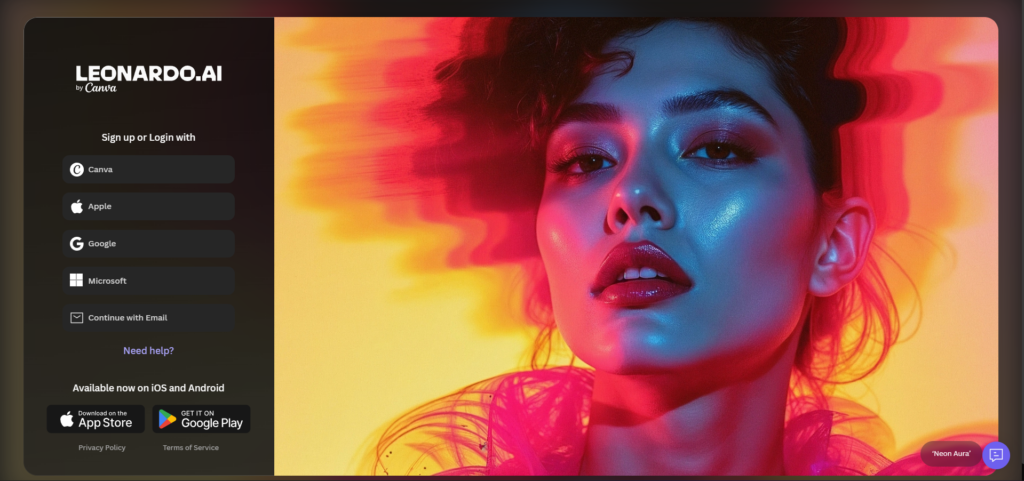
Step 1: Create your account. Go to app.leonardo.ai and click “Sign Up.” You can register using your Google, Apple, or Microsoft account. There is no credit card required for the free plan. After signing in, the platform asks you to select your primary interest (such as game assets, marketing, or illustration). This personalises your community feed but does not restrict what you can generate.
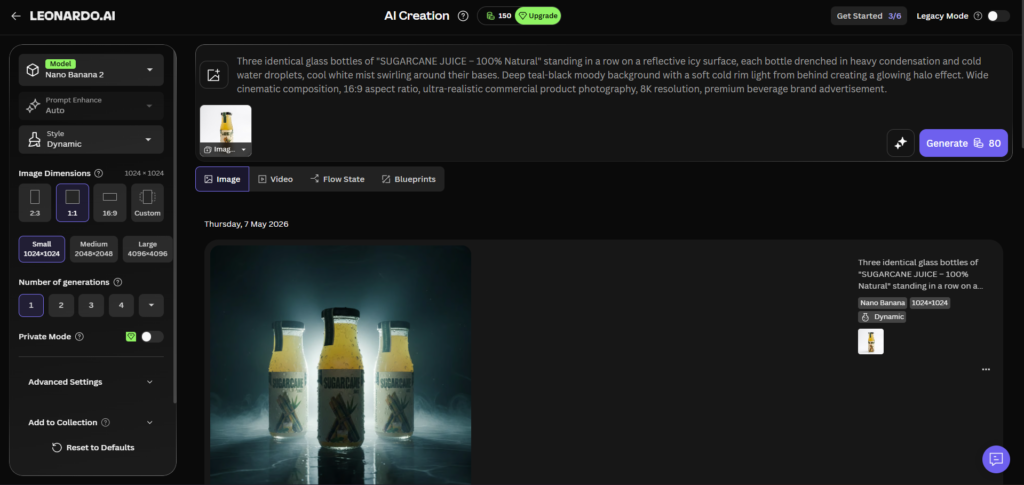
Step 2: Go to AI Image Generation. Once you are inside the dashboard, click “AI Image Generation” in the left sidebar. You will land on the main generation interface. Your daily token balance of 150 is visible in the top navigation bar.
Step 3: Choose your model. Click the model selector below the prompt box. For general use, select Leonardo Phoenix. It produces strong, detailed results across a wide range of prompt types. If you want to generate a quick concept sketch using fewer tokens, Flux Schnell is a faster, lighter option.
Step 4: Write your prompt and set your dimensions. Type a clear, descriptive prompt in the text box. Be specific about subject, style, lighting, and mood. For your first generation, try something like: “A quiet forest path in autumn, golden light filtering through the trees, photorealistic, high detail.” Set the output dimensions to 1024×1024 for a good balance of quality and token cost.
Step 5: Check the token cost and generate. The token cost for your current settings appears on the Generate button. If it looks higher than expected, reduce the resolution or switch to a faster model. When you are happy, click Generate. Your image typically appears within 15 to 30 seconds, though queue times during peak hours can be longer.
Step 6: Download your image. Click the generated image to open the full view. From there, you can download it, open it in the AI Canvas for editing, or add it to a collection in your account.
Free Plan Compared to Paid Plans and Competitors
| Plan | Daily or Monthly Tokens | Private Generations | LoRA Training | Commercial Rights | Cost |
|---|---|---|---|---|---|
| Leonardo Free | 150 tokens/day (no rollover) | No — all images public | No | Yes (but platform retains ownership) | Free |
| Leonardo Apprentice | 8,500 tokens/month + rollover | Yes | 1 slot/month | Full ownership | $12/mo ($10 annual) |
| Leonardo Artisan | 25,000 tokens/month + rollover | Yes | 5 slots/month | Full ownership | $30/mo ($24 annual) |
| Midjourney Basic | ~200 fast GPU minutes | Yes | No | Yes (paid plans) | $10/mo |
| DALL-E 3 via ChatGPT Free | Limited image generations/day | Yes | No | Yes | Free (with limits) |
| Adobe Firefly Free | 25 generative credits/month | Yes | No | Yes (with commercially safe training data) | Free |
A few things worth pointing out from this table. Midjourney offers no free plan at all. If you want to test Midjourney before paying, you cannot. Leonardo’s 150 daily tokens are comparable to the free tier on some other platforms in terms of practical output volume, but the model quality available on the free plan is above average for a no-cost tier.
DALL-E 3 through the free version of ChatGPT is available but comes with daily generation limits and less granular control over output settings. Adobe Firefly’s free plan gives you 25 generative credits per month, which is considerably lower than Leonardo’s 4,500 monthly equivalent (150 per day times 30 days). For pure volume on a zero-cost plan, Leonardo is one of the better options available.
If you want a broader look at how different AI image tools compare across use cases, our complete guide to Leonardo AI covers the full competitive landscape in detail.
Who the Free Plan Is Genuinely Good Enough For?
Hobbyists and casual creators. If you are generating images for personal projects, social posts, desktop wallpapers, or just exploring what AI image generation can do, 150 tokens per day is a workable daily budget. You can produce 10 to 20 images per day at reasonable quality without spending anything.
Students and learners. The free plan is well-suited to anyone studying design, digital art, or AI tools. You get access to the same core models that professionals use, and you can work through the platform’s features without a financial commitment. This makes it a practical learning environment for anyone building skills in AI-assisted creative work.
Bloggers and content creators evaluating a tool. If you are testing whether Leonardo fits into your content workflow, the free plan gives you enough daily output to make a genuine assessment over a week or two. You can generate blog header images, thumbnail concepts, and social media visuals and see whether the quality and workflow actually suits how you work. For more on using AI tools as part of a content strategy, see our article on AI tools for content creation.
Anyone not doing client work or confidential projects. The public gallery requirement is a firm line. If your use case involves anything you would not want to appear in a public image database, the free plan is not appropriate. For everyone else, the absence of a payment barrier makes it a sensible starting point.
Backlink Opportunities
These are real, relevant sites where you can pursue backlinks through guest posts, resource page outreach, or tool listings. All are genuinely relevant to this article’s topic.
- Zapier Blog — Publishes beginner-friendly AI tool roundups and “best free AI tools” lists. Pitch a guest post or ask for inclusion in their AI image generator comparison articles.
- G2 Learn Hub — Actively publishes software comparison and review content. You can submit your article as a reference source when they cover Leonardo AI or AI image generators.
- HubSpot Blog — Covers AI tools for marketers and creators. Their “free AI tools for marketers” articles are good placement targets. Pitch a contributor post referencing your free plan breakdown.
- Elegant Themes Blog — Popular among WordPress bloggers and designers. They regularly publish AI tool guides. Outreach for guest post or resource link.
- TechRadar — Covers AI tools and software reviews. Editors update their “best AI image generators” roundups regularly. Submit your URL as a cited resource via their tips or editorial contact.
- Creative Bloq — Design-focused publication that covers AI art tools frequently. Guest contributor submissions accepted. Your free plan deep-dive is a strong fit for their audience.
- MakeUseOf — Publishes how-to and beginner AI tool guides constantly. Accepts guest writers. A “how to use Leonardo AI for free” pitch aligns well with their format.
- SitePoint — Targets designers, developers, and digital creatives. They accept community articles and tutorial-style posts. Strong fit for an AI tools free plan breakdown.
- Product Hunt — Submit your article as a resource in the Leonardo AI product discussion thread. Relevant comments with your link drive referral traffic and domain diversity.
- AlternativeTo — A tool directory where users discuss and compare software. Add Edurancehub as a referenced resource in the Leonardo AI listing comments or suggest it to the editorial team.
Frequently Asked Questions
Does the Leonardo AI free plan ever expire?
No. According to Leonardo’s own FAQ, the free tier has no expiry date. You can use the 150 daily tokens indefinitely without ever upgrading. The platform does not put a time limit on free access or force you into a paid plan after a trial period. Your daily token reset will continue as long as your account is active.
Can I use Leonardo AI free plan images to sell products?
Technically yes, Leonardo’s terms allow commercial use even on the free plan. However, there is an important distinction. On the free plan, Leonardo AI owns the assets you generate, and those images are public. Another user could find your design in the community gallery and use it for a similar purpose. If you need exclusive rights to an image for commercial use, such as a logo, product label, or unique print design, you need a paid plan. The Apprentice plan at $12 per month gives you full intellectual property ownership and private generation.
What happens when I run out of 150 tokens on the free plan?
Once your 150 daily tokens are used up, you cannot generate more images until the next day’s reset. Unlike paid plans, which have a Relaxed Generation mode that lets you continue generating at a slower queue after tokens are depleted, the free plan simply stops. You will need to wait for your next daily reset or upgrade to a paid plan to continue.
Are the models on the free plan the same quality as on paid plans?
Yes. Free plan users have access to the same core models including Leonardo Phoenix, which is the platform’s flagship proprietary model for detailed, prompt-adherent generation. The difference is not in model access but in daily volume (150 tokens versus thousands per month), queue priority (paid users process faster), and feature access (no LoRA training, no private mode, no rollover). The image quality you can achieve at the maximum resolution within 150 tokens is the same quality a paid user would get with the same settings.
Does the Leonardo AI free plan include video generation?
Basic video motion features may be accessible on the free plan, but video generation is extremely token-intensive. A 5-second clip using the Veo 3 model costs 2,500 tokens per generation. That is 17 days’ worth of free tokens for a single 5-second video. Practically speaking, meaningful video generation on the free plan is not feasible. If video is your primary use case, a paid plan with a substantial monthly token pool is necessary.
Is there a free trial for paid plans before committing?
No. According to Leonardo’s official FAQ page, the platform does not offer free trials for paid consumer plans. The recommendation from Leonardo itself is to purchase a plan and cancel if it does not meet your needs. However, the permanent free tier functions as an ongoing evaluation environment. You can use the free plan for as long as needed to understand the platform before upgrading, which makes the absence of a formal free trial less of a concern than it would be on platforms with no free tier at all.
Final Thoughts
The Leonardo AI free plan is more generous than most comparable tools in the category. The model access is real, the 150 daily tokens are enough for genuine creative exploration, and the platform does not put an expiry clock on your access. For hobbyists, learners, and anyone testing whether AI image generation fits into their workflow, it is a reasonable starting point with no financial risk.
The limits that matter are the public gallery requirement and the absence of LoRA training. If either of those is a problem for your specific use case, you will know within the first few days of using the free plan whether upgrading is worth it. The Apprentice plan at $12 per month resolves both issues, and most users who find themselves reaching those limits will find the upgrade straightforward to justify.
Start with the free plan at app.leonardo.ai, spend a week using it regularly, and track how quickly you exhaust your daily tokens. That usage pattern will tell you everything you need to know about whether staying free is sustainable or whether a paid plan earns its cost. For a full comparison of all paid options, see our Leonardo AI pricing breakdown.