The ElevenLabs API is what powers everything from indie apps with a single voice feature to enterprise call centers running thousands of conversations a day, but most documentation assumes you already understand the platform’s broader pricing and product structure before you start reading endpoint references. This guide covers what a developer actually needs to know before writing the first line of integration code, including where the real costs show up and which architectural decisions are hardest to reverse later.
Table of Contents
What Is the ElevenLabs API?
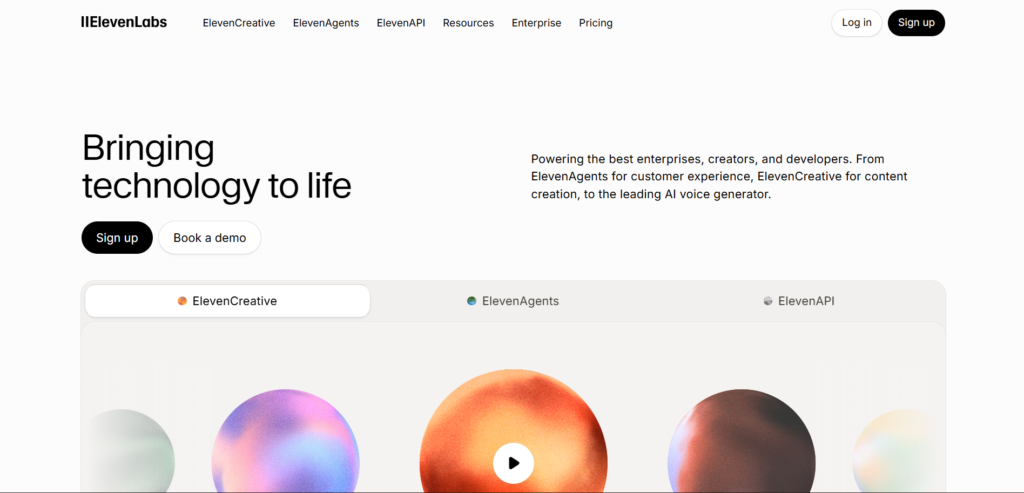
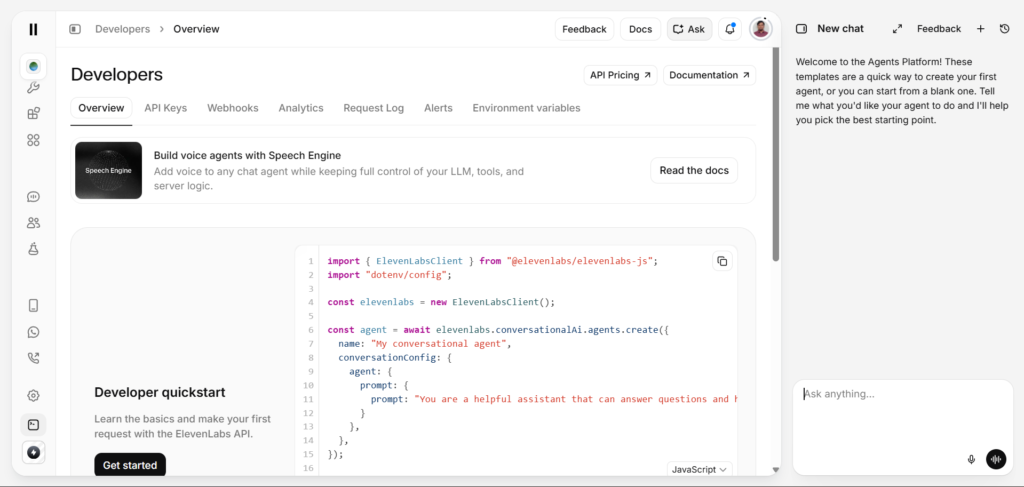
The ElevenLabs API is the developer layer underneath every consumer-facing ElevenLabs product, giving programmatic access to text-to-speech, voice cloning, dubbing, and conversational AI capabilities that businesses can build directly into their own applications. Rather than using the web interface manually, developers send requests to specific endpoints and receive generated audio, or in the case of conversational agents, manage real-time voice interactions entirely through code.
The API is organized around several core capability areas mirroring the consumer product structure. Text-to-speech endpoints convert written text into spoken audio using either the Flash model for low-latency applications or Multilingual V2 for higher quality output. Voice endpoints handle cloning, allowing an application to create and manage custom voice profiles programmatically rather than through the manual web interface. Conversational AI endpoints support building real-time voice agents capable of handling phone calls or live voice interactions with a connected knowledge base.
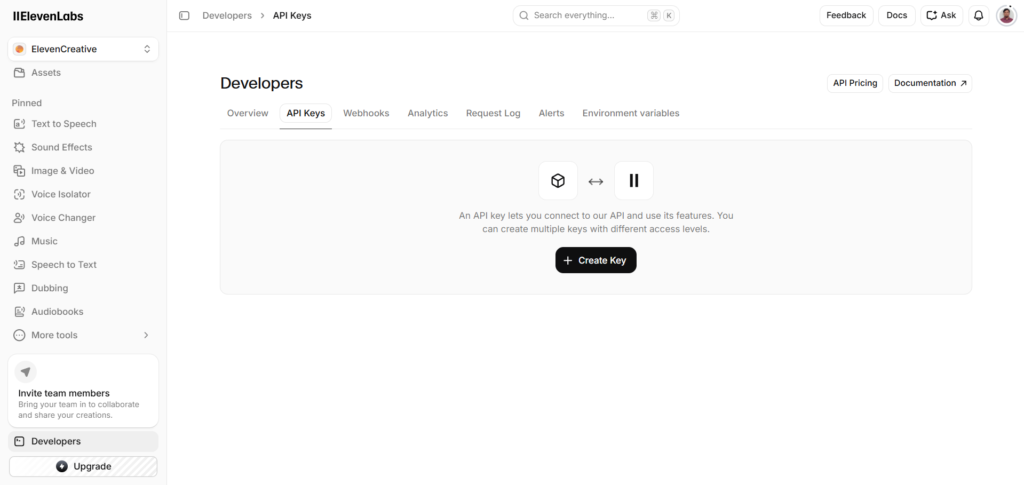
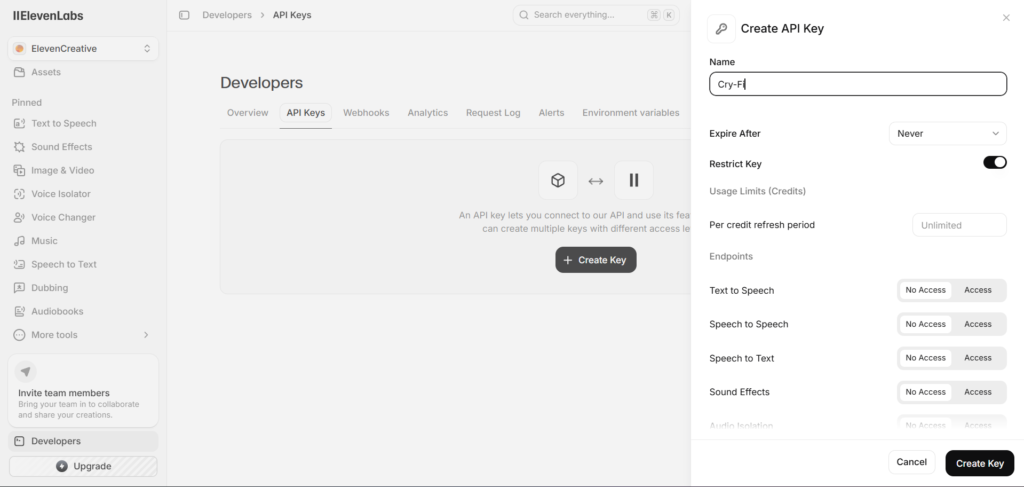
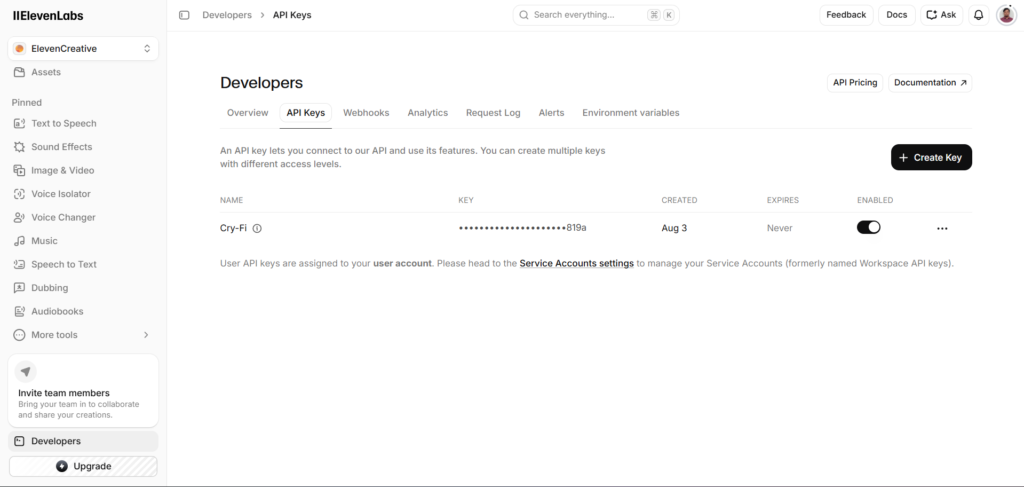
Authentication works through an API key generated in your ElevenLabs account settings, passed with each request rather than requiring a more complex OAuth flow for most standard use cases. This relatively simple authentication model lowers the barrier to a first working integration considerably compared to platforms requiring more elaborate credential setup before any code can actually run successfully.
For the broader context of what the API sits underneath, our ElevenLabs Review 2026: 9 Honest Truths About the AI Voice Tool Everyone’s Cloning covers the full consumer product lineup, which is worth understanding since the API generally mirrors the same feature boundaries, Instant versus Professional Voice Cloning, Flash versus Multilingual V2, that exist on the standard subscription plans.
Why Developers Reach for a Dedicated Voice API Instead of Building In-House?
Building a natural sounding text-to-speech system from scratch requires substantial machine learning expertise, significant training data, and ongoing model maintenance that most product teams simply cannot justify investing in when their actual business is something other than voice synthesis itself. This is the core reason dedicated voice API providers like ElevenLabs exist and continue growing, since even large, well-resourced companies generally find it more efficient to integrate a mature third-party voice API than to develop comparable capability internally.
This calculation shifts somewhat for companies where voice technology is genuinely core to their product, but for the vast majority of applications adding a voice feature as one component among many, the API route remains dramatically more practical than an in-house alternative, both in initial development time and in the ongoing cost of keeping pace with a rapidly improving field.
How the ElevenLabs API Actually Works?
Understanding the practical mechanics of the API, beyond just the available endpoints, helps developers avoid common early mistakes that only become apparent once an integration is already in production.
Request and Response Structure
Most text-to-speech requests follow a straightforward pattern, sending text along with a specified voice ID and model, and receiving generated audio back, either as a direct binary response or a streaming response for lower-latency applications. Streaming support matters significantly for any application where perceived response time affects user experience, since waiting for a complete audio file to generate before playback begins feels noticeably slower than audio that begins playing as it streams.
Rate Limits and Concurrency
API access includes rate limits that scale with your specific subscription tier, governing both how many requests you can send and how many concurrent generations can run simultaneously. Applications expecting to serve many simultaneous users, particularly for conversational AI use cases involving live phone calls, need to plan capacity around these concurrency limits carefully rather than assuming unlimited simultaneous throughput regardless of plan tier.
Voice Management at Scale
For applications managing many cloned voices programmatically, such as a platform offering personalized narration to many individual users, the API provides endpoints for creating, listing, and deleting voice profiles without manual intervention through the web interface. This becomes essential architecture for any product built around user-generated voice cloning at meaningful scale, though it also means the application layer bears responsibility for managing consent verification workflows appropriately for each end user.
Webhooks and Asynchronous Processing
For longer-running tasks, particularly dubbing jobs that can take meaningful processing time for longer video content, the API supports webhook notifications rather than requiring the calling application to poll continuously for completion status. Building around this asynchronous pattern from the start avoids the common early mistake of architecting an integration around synchronous, blocking requests that work fine in testing but create real problems once request volume and content length increase in production.
This distinction between synchronous and asynchronous processing patterns is one of the more consequential early architectural decisions in a voice API integration. A prototype built entirely around short, quick text-to-speech calls can create a false sense of simplicity that breaks down the moment a real feature, like dubbing a lengthy video, requires handling a process that genuinely takes minutes rather than seconds to complete.
Step-by-Step Guide to Integrating the ElevenLabs API
Here is a practical path to a working integration, covering the decisions that matter most before you write production code.
Step 1: Validate Your Use Case With the Standard Web Interface First
Before writing any integration code, use the standard ElevenLabs web app to confirm voice quality and generation behavior actually fit your use case. This costs nothing in engineering time and prevents building an integration around a product capability that turns out not to match your real requirements once tested properly.
Step 2: Generate Your API Key and Review Documentation
Create your API key in account settings, then review the official documentation for the specific endpoints relevant to your use case, text-to-speech, voice cloning, or conversational AI, rather than trying to absorb the entire API surface at once.
Step 3: Build a Minimal Proof of Concept
Start with the simplest possible working integration, a single text-to-speech call returning audio, before adding voice cloning, streaming, or webhook handling. This isolates problems more effectively than attempting a full-featured integration on the first attempt.
Step 4: Plan for Streaming if Latency Matters
If your application involves any real-time or near-real-time interaction, implement streaming response handling from the start rather than retrofitting it later, since the architectural difference between a blocking request and a streaming one affects your application’s structure more fundamentally than a simple configuration change.
Step 5: Estimate Real Cost Per Feature Before Scaling
Calculate your expected cost per unit of usage, per character for text-to-speech, per minute for conversational AI, against your actual expected user volume, rather than extrapolating from a small test batch that may not reflect real production usage patterns accurately.
Step 6: Implement Proper Error Handling for Rate Limits
Build retry logic and graceful degradation for rate limit responses specifically, since any application expecting meaningful traffic will eventually encounter rate limiting, and how your application handles that moment significantly affects real user experience during peak usage.
Step 7: Set Up Monitoring Before Full Production Launch
Implement logging and monitoring around API usage and cost specifically before launching to real users, since discovering a cost or performance problem after significant user adoption is considerably more disruptive than catching it during a controlled, monitored rollout.
Key Benefits of the ElevenLabs API
The API’s alignment with the consumer product’s feature structure means developers who have already tested voice quality through the standard web interface can predict integration behavior reasonably well, reducing the uncertainty that often accompanies building against an unfamiliar API from documentation alone.
Streaming support genuinely matters for real-time applications, and having this built into the core API rather than requiring a separate premium tier or add-on removes a common friction point developers encounter with less mature audio API providers.
The relatively simple API key authentication model lowers the barrier to a working prototype considerably, letting developers validate a concept quickly before investing in more elaborate infrastructure, a genuine advantage for early-stage products still proving out whether voice features justify further investment.
Enterprise deployment flexibility, including dedicated infrastructure options for very high volume or compliance-sensitive applications, means the same underlying API can scale from an indie developer’s weekend project through to a large enterprise deployment without requiring a fundamentally different integration approach at each stage.
The API’s consistency across ElevenLabs’ different capability areas, text-to-speech, cloning, dubbing, and conversational AI, means developers who become familiar with the platform’s general authentication and request patterns through one feature area can extend into another without needing to essentially relearn an entirely different system from scratch.
Comparison Table
| API Provider | Streaming Support | Voice Cloning via API | Conversational AI Support | Entry Pricing Model |
|---|---|---|---|---|
| ElevenLabs | Yes, native | Yes, both Instant and Professional | Yes, dedicated endpoints | Credit-based, from Pro tier |
| Amazon Polly | Yes, native | Limited | No | Pay-as-you-go, per character |
| Google Cloud Text-to-Speech | Yes, native | Limited | No | Pay-as-you-go, per character |
| Play.ht | Yes, native | Yes | Limited | Credit-based subscription |
| Resemble AI | Yes, native | Yes, developer-focused | Yes | Custom, usage-based |
Pricing and feature availability reflect publicly listed information as of mid-2026. API-first competitors like Resemble AI and Play.ht are worth evaluating alongside ElevenLabs specifically for developer-focused use cases, since consumer-facing tools without a mature API offering are generally a poor fit for production integration work regardless of their standalone product quality.
Who the ElevenLabs API Actually Works Best For?
Indie developers and small startups building a single voice-enabled feature into a broader product benefit from the API’s relatively low barrier to entry, letting a small team validate whether voice functionality genuinely improves their product before committing significant engineering resources to a deeper integration.
Businesses building customer service or sales automation specifically should focus on the conversational AI endpoints, a use case covered in dedicated depth in our guide on ElevenLabs Conversational AI 2026: 6 Reasons Call Centers Are Quietly Switching, since building a genuinely reliable phone-based voice agent involves meaningfully more architectural complexity than a simple text-to-speech integration.
Content platforms offering personalized narration or dubbing at scale, audiobook platforms, educational content providers, or localization services, benefit from the API’s voice management and dubbing endpoints, which are built specifically for programmatic, high-volume use rather than manual, one-at-a-time generation through the web interface.
Enterprise teams with strict compliance or data residency requirements should specifically evaluate available dedicated infrastructure and deployment options before committing to a standard API integration, since retrofitting compliance requirements onto an already-built integration is considerably more disruptive than planning for them from the start.
FAQ
How much does the ElevenLabs API cost?
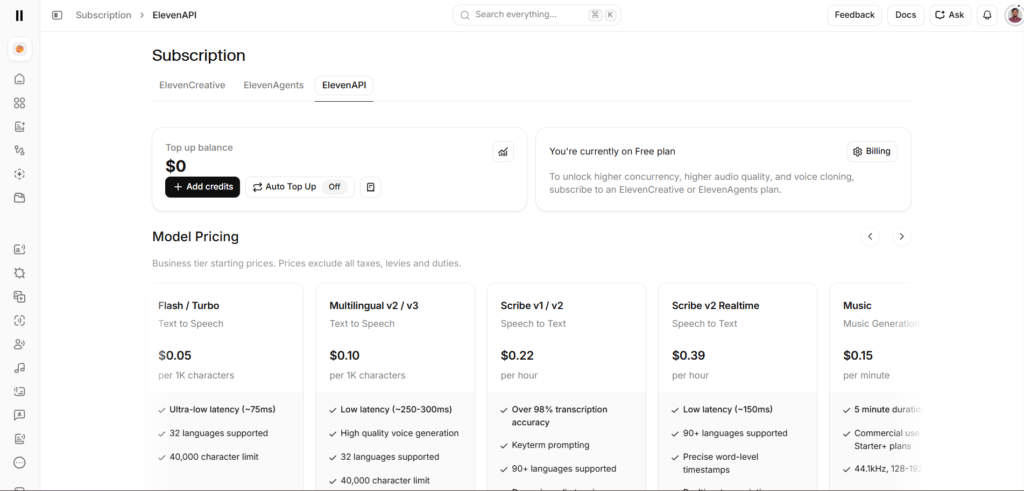
API pricing generally follows the same underlying credit and character-based logic as the consumer subscription plans, with cost scaling based on usage volume, characters processed for text-to-speech or minutes for conversational AI. Developers should calculate expected cost per unit of usage against their real anticipated volume before committing to production, since costs that seem negligible during a small test batch can scale meaningfully once an application reaches genuine production traffic levels.
Does the ElevenLabs API support real-time voice generation?
Yes, the API supports streaming responses specifically for low-latency, real-time use cases, and the Flash model is specifically optimized for this kind of application where perceived delay directly affects user experience. Conversational AI applications in particular depend heavily on this real-time capability, since any noticeable lag in voice response breaks the natural feel of a live conversation in a way that would be far less noticeable in a non-interactive, pre-recorded context.
Can I clone voices programmatically through the ElevenLabs API?
Yes, the API includes endpoints for creating and managing voice clones programmatically, supporting both Instant and Professional Voice Cloning depending on your specific plan tier. Applications built around user-generated voice cloning at scale, such as a platform letting individual users create their own personalized voice profile, need to handle consent verification workflows carefully within their own application logic, since the responsibility for ensuring proper authorization does not disappear simply because the cloning process itself is automated through the API.
What programming languages does the ElevenLabs API support?
The ElevenLabs API is a standard REST API, meaning it can be integrated using essentially any programming language capable of making HTTP requests, including Python, JavaScript, Java, and others. Official SDKs and community libraries exist for several popular languages, simplifying integration compared to constructing raw HTTP requests manually, though the underlying REST structure means the API remains accessible even in languages without a dedicated official SDK available.
Is there a free tier for testing the ElevenLabs API?
Yes, developers can test API functionality using the same free tier credits available to standard consumer accounts, though production use, particularly anything involving commercial applications, generally requires at least a paid plan for both sufficient usage volume and appropriate commercial licensing terms. Testing thoroughly on the free tier before committing to a paid plan is a reasonable approach for validating a concept before any real financial commitment to the platform.
How reliable is the ElevenLabs API for production applications handling high volume?
ElevenLabs offers dedicated infrastructure options and enterprise-level service agreements specifically for high volume, production-critical applications, distinct from the standard shared infrastructure that smaller integrations typically use. Applications with strict uptime or latency requirements should specifically discuss these enterprise deployment options directly with ElevenLabs rather than assuming standard API access alone provides sufficient reliability guarantees for a mission-critical production system serving significant traffic, since the gap between standard and enterprise tier reliability guarantees can matter significantly once real revenue depends on consistent uptime.
Final Thoughts
The ElevenLabs API rewards developers who take the time to validate their use case through the standard web interface before writing integration code, and who plan for streaming, error handling, and realistic cost estimation from the start rather than retrofitting these considerations after an initial proof of concept already works in a limited testing environment.
The gap between a working demo and a genuinely production-ready integration is often wider than it initially appears, particularly for anything involving real-time conversational AI or high-volume voice cloning at scale. Taking the architectural decisions covered in this guide seriously from the outset saves considerably more engineering time than treating them as later optimizations.
As with any third-party API a product depends on, it is worth building in some resilience against future changes, whether pricing adjustments, rate limit changes, or feature deprecations, rather than architecting an integration so tightly coupled to current API behavior that any future change requires a substantial rebuild rather than an incremental update.
Start with a minimal proof of concept validating your core use case, estimate real costs against your actual expected volume, and build toward production incrementally rather than attempting a fully-featured integration on the first pass.
External Links:
- https://elevenlabs.io/docs
- https://elevenlabs.io/docs/api-reference
- https://elevenlabs.io/pricing
- https://github.com/elevenlabs
- https://elevenlabs.io/conversational-ai
- https://docs.claude.com
- https://stackoverflow.com/questions/tagged/elevenlabs
- https://www.postman.com
- https://aws.amazon.com/polly/
- https://cloud.google.com/text-to-speech