

I almost published an entirely wrong pricing breakdown for this article. Google restructured its entire Gemini subscription ladder on May 19, 2026, four days before I started writing this, and most of the articles I read while researching were already quoting outdated numbers from before that change. So I went directly to Google’s live subscription page, verified every figure myself, and spent two weeks actually using each tier to see whether the new pricing structure makes sense for US subscribers. Here is the real, current breakdown.
Table of Contents
The May 2026 Restructure: What Actually Changed?
Google announced the AI plan restructure on May 19, 2026 as part of the Google I/O 2026 keynote. The changes were material, not cosmetic. A new tier was introduced, the top tier was repriced, and the usage model itself shifted from fixed daily caps to a compute-credit system refreshing on a five-hour cycle.
Before this restructure, Google AI Plus cost more, there was only one Ultra tier priced at $249.99 per month, and AI Pro was widely quoted across the internet at approximately $30 per month, a figure that was simply wrong even before the restructure for most US subscribers. After May 19, the lineup looks like this: AI Plus dropped to $7.99 per month, AI Pro settled at $19.99 per month, a new $99.99 Ultra tier launched aimed at developers, and the existing $250 Ultra tier was cut to $200.
If you are researching Gemini pricing right now and find an article quoting AI Pro at around $30 per month, that article predates this restructure and should not be trusted for current decision-making. The verified live price, confirmed directly from Google’s official subscription page, is $19.99 per month, with 50 percent off the first year for new subscribers.
The Free tier did not receive a price change, since it remains $0, but it did receive a meaningful model upgrade. During the I/O 2026 keynote, Google announced that the default model for the free tier in the US was upgraded from Gemini 3 Flash to Gemini 3.5 Flash, the same model powering Google’s AI Mode search surface used by over a billion monthly active users.
Free: What You Actually Get at Zero Cost?
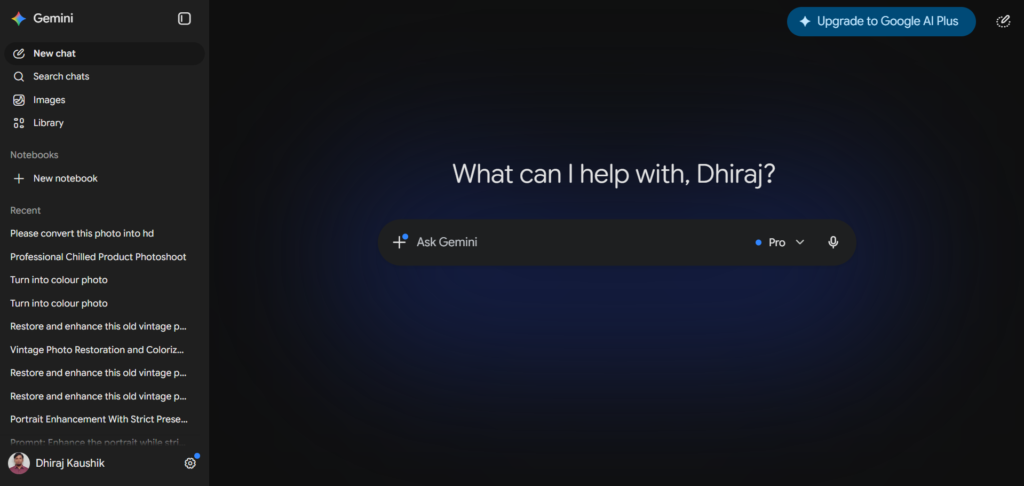
The free tier remains genuinely usable in 2026, more so than it was before the restructure. US users now get Gemini 3.5 Flash as the default model in the standard Gemini app tier, subject to a daily quota, alongside a limited daily allotment of the more capable Gemini 3.1 Pro.
Deep Research, Gemini’s autonomous research feature, is available on the free plan but capped at 5 uses per month. You also get basic image generation, Gemini Live voice mode at no cost, Canvas for document and code work, and Gems for building custom assistants, along with 15GB of standard Google One storage shared across Gmail, Drive, and Photos.
What the Free tier does not include is just as important to understand. There is no Veo 3.1 video generation beyond very limited access, no meaningful Imagen 4 or Nano Banana Pro image generation at scale, no Project Mariner, no Deep Think extended reasoning, and no significant AI Credits allocation for premium features. The Free tier is Gemini for chat and search. It is not a substitute for a paid plan for anyone doing regular creative or agentic work.
For evaluation purposes, the free tier in its post-restructure form is one of the more generous options available among major AI platforms in 2026, largely because it now runs a genuinely current flagship-adjacent model rather than a deliberately weakened version.
Google AI Plus: The $7.99 Tier Nobody Is Talking About
This is the tier most US coverage missed entirely, and it deserves more attention than it has gotten. AI Plus rolled out globally at I/O 2026, including to US users who previously had no access to anything at this exact price point from Google.
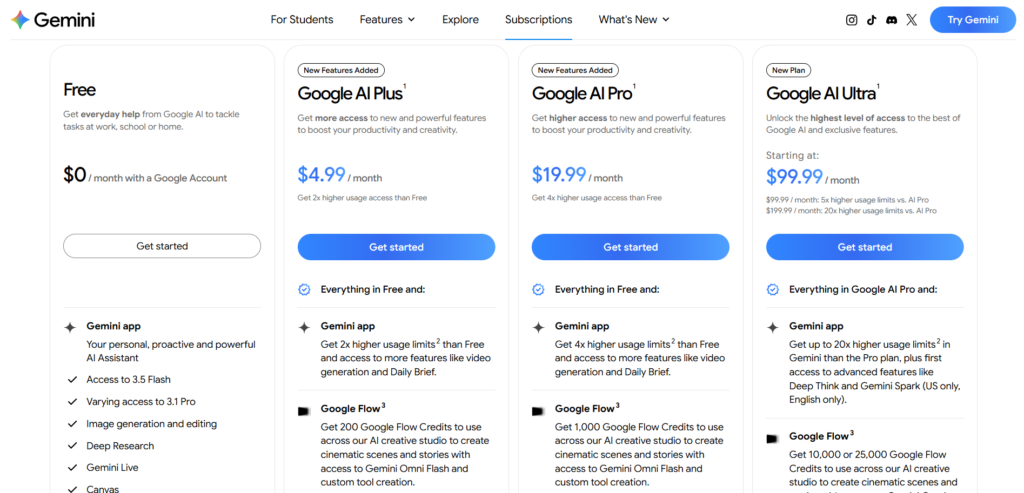
At $7.99 per month, AI Plus is the only sub-$10 AI subscription from a major vendor that includes a full, though capped, frontier model. You get Gemini 3 Pro access with usage limits, 200GB of Google One storage, Veo 3.1 Fast video generation, 12 Deep Research reports per day, and 200 AI Credits per month.
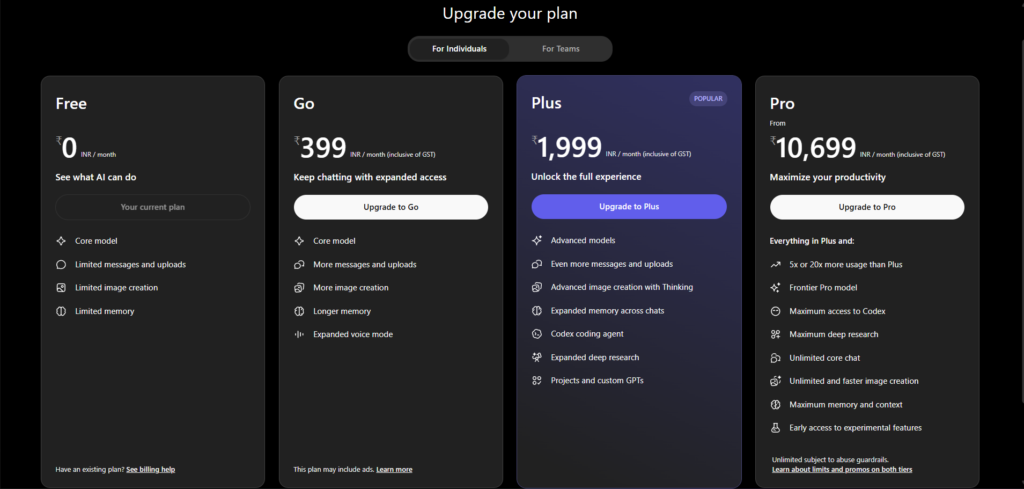
Comparing this to alternatives in the same price bracket makes the value proposition clear. ChatGPT Go exists at a comparable $8 price point but offers limited GPT-5.x access without the storage bundle or video generation that AI Plus includes. Claude currently has no equivalent subscription tier under $20 at all. For US users who want meaningfully more than the free tier but do not need the full 1 million token context window or unlimited Deep Research that AI Pro provides, AI Plus is a genuinely underrated entry point that most comparison articles have not caught up to covering properly yet.
Google AI Pro: The $19.99 Sweet Spot
Google AI Pro is $19.99 per month and includes Gemini 3.1 Pro with a 1 million token context window. This is the tier most US professionals should default to evaluating first, and it is the one most affected by outdated pricing information circulating online.
At $19.99, AI Pro matches ChatGPT Plus on price exactly but includes meaningfully different bundled value. You get 5TB of Google One storage, Veo 3.1 Lite video generation, the Jules coding agent at five times the free allowance, and a $10 per month Google Cloud credit that ChatGPT Plus does not offer at any price. Pro subscribers also receive 20 Deep Research sessions per day, a substantial increase over the free tier’s monthly cap of 5.
US subscribers specifically get full Gemini 3 model access as part of this tier, along with Gemini integration directly inside Gmail and Docs, higher limits in Gemini Code Assist and the Gemini CLI for developers, and the upgraded NotebookLM experience with 5 times the audio overview capacity of the free tier.
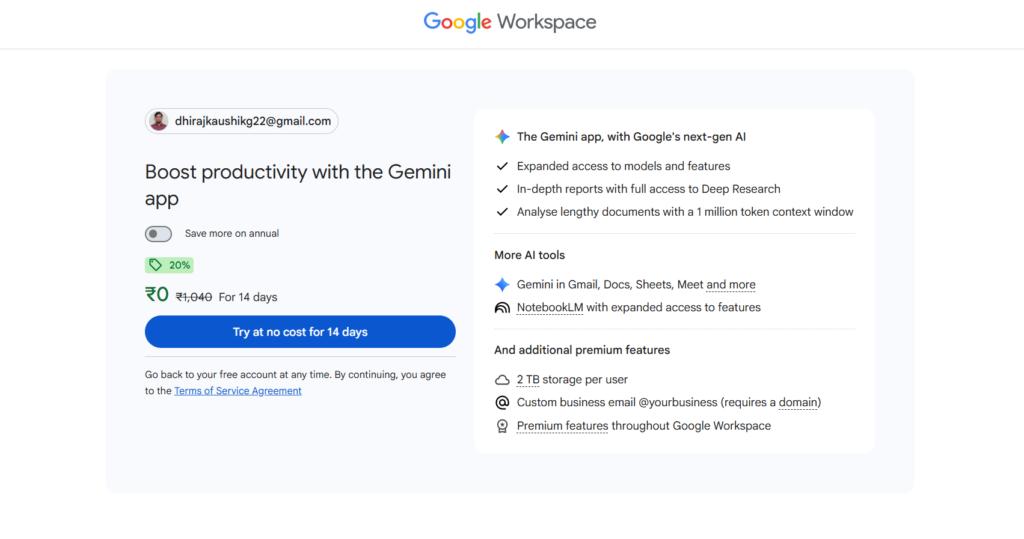
New subscribers should specifically check for the 50 percent first-year discount when signing up, which substantially reduces the effective monthly cost during your first 12 months on the plan. This discount has appeared consistently in verified pricing checks throughout 2026 but is easy to overlook in the checkout flow if you are not specifically looking for it.
Google AI Ultra: Now Split Into Two Tiers
This is the most significant structural change from the restructure, and one that most articles published before May 19 simply could not have covered because the second tier did not exist yet.
Before I/O 2026, there was a single Ultra tier priced at $250 per month. After May 19, there are two distinct Ultra tiers serving different audiences. The new entry-level Ultra tier costs $99.99 per month and is explicitly developer-focused, offering 5 times Pro’s usage limits, 20TB of storage, a $100 monthly Google Cloud credit, and access to the Gemini Spark Beta program. Critically, this tier does not include Project Genie or Project Mariner, Google’s more advanced agentic features.
The existing top Ultra tier was reduced from $250 to $200 per month, and it retains exclusive access to Project Genie and Project Mariner, alongside 20 times Pro’s usage limits, 30TB of storage, and 12,500 monthly AI Credits. US subscribers on this top tier also get Gemini 3 Pro integrated into AI Mode for Google Search, the highest available limits in Gemini Code Assist and CLI, full YouTube Premium rather than the Lite version included on Pro, and the Google Home integration.
The practical implication of this split: if you saw “Ultra” advertised somewhere and assumed it meant the $250 (now $200) flagship tier, double-check which Ultra tier is actually being discussed, since the new $99.99 entry point uses the same brand name but delivers a meaningfully different and more limited feature set.
Full Side-by-Side Comparison Table
| Feature | Free | AI Plus | AI Pro | AI Ultra ($99.99) | AI Ultra ($199.99) |
|---|---|---|---|---|---|
| Monthly Price | $0 | $7.99 | $19.99 | $99.99 | $199.99 |
| Primary Model | Gemini 3.5 Flash | Gemini 3 Pro (capped) | Gemini 3.1 Pro | Gemini 3.1 Pro | Gemini 3.1 Pro + Deep Think |
| Context Window | 32K tokens | 128K tokens | 1M tokens | 1M+ tokens | 1M+ tokens |
| Storage | 15GB | 200GB | 5TB | 20TB | 30TB |
| Deep Research | 5/month | 12/day | 20/day | Higher allowance | Highest allowance |
| Video Generation | Very limited | Veo 3.1 Fast | Veo 3.1 Lite, ~1,000 credits | Higher Veo allowance | Highest Veo allowance |
| Google Cloud Credit | None | None | $10/month | $100/month | Included, higher tier |
| Project Genie/Mariner | No | No | No | No | Yes, exclusive |
| YouTube Premium | No | No | Lite version | Not specified | Full version |
| Best For | Casual evaluation | Budget users wanting a real model | Daily professional use | Developers needing storage/credits | Power users, agentic work |
This table reflects verified figures as of late May and June 2026. Given how recently this restructure happened, treat any pricing information you find elsewhere with caution unless it explicitly references the May 19, 2026 changes.
How the Usage Model Changed: Compute Credits vs Daily Caps
This is a structural change that matters more than the headline prices, and it is easy to miss entirely if you are only comparing dollar figures between old and new pricing.
Google shifted the usage model itself from fixed daily caps to a compute-credit system that refreshes on a five-hour cycle. Previously, you might have had a simple daily limit, for example 100 prompts per day on a given model, that reset once every 24 hours. The new system allocates a rolling compute budget that refreshes every five hours, with an overarching weekly ceiling layered on top.
In practical terms, more complex tasks, including extended reasoning, Deep Think, media generation, and Deep Research, consume more of this compute budget per request than simple conversational exchanges. During my two weeks of testing across AI Pro specifically, I noticed this most clearly when running multiple Deep Research reports in a single morning. Under the old daily-cap system, the limit was predictable. Under the new compute-window system, heavy usage in a short period can reduce your remaining capacity for the rest of that five-hour window in a way that is genuinely harder to predict in advance.
For typical daily use, casual conversation, routine writing tasks, and occasional research, this change is barely noticeable in practice. For anyone running intensive, multi-hour work sessions involving heavy Deep Research or media generation, understanding this shift is worth doing before assuming your usage will behave exactly like it did under the old system, even at the same subscription tier and price.
Student Discount: Free Google AI Pro for a Full Year
This is one of the best-kept deals in the entire Gemini pricing structure for US users specifically. The student program provides a full year of Google AI Pro access at no cost, available to college students in the United States who can verify their enrollment status.
The verification process uses SheerID, a third-party academic verification service, and typically requires only a valid .edu email address along with enrollment confirmation. Once approved, you receive the complete Google AI Pro experience, including Gemini 3.1 Pro access, the full storage allocation, and Deep Research at the Pro-tier rate, for twelve consecutive months without payment.
After the free year ends, your subscription automatically converts to a standard paid plan, so mark your calendar to evaluate at that point whether to continue paying, downgrade to the cheaper AI Plus tier, or cancel entirely depending on how your usage has evolved over the year. For a verified US student, there is no compelling reason not to claim this if you are at all likely to use Gemini’s paid features during your studies. Verify current eligibility and the application process directly at google.com/edu/gemini before assuming the offer terms exactly match what is described here, since Google has adjusted program details multiple times through 2026.
Gemini Pricing vs ChatGPT and Claude
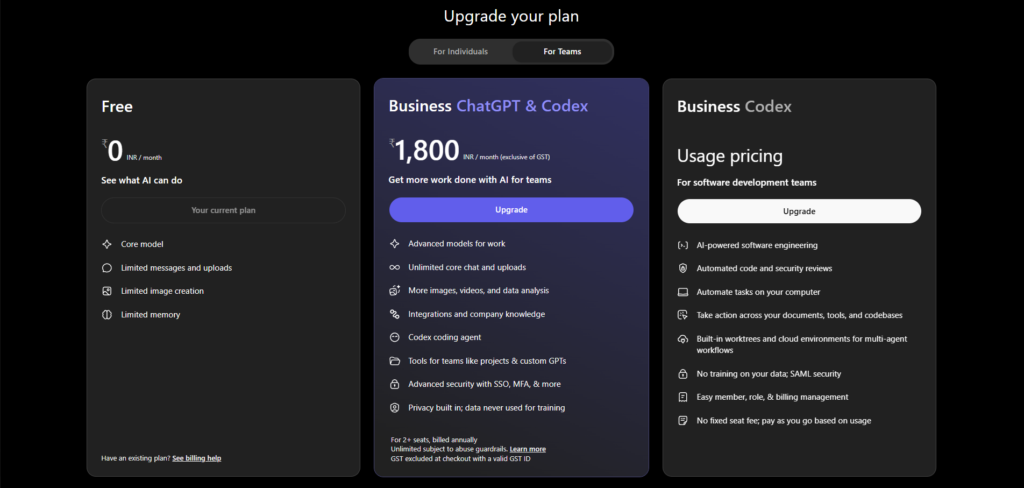
All three major consumer AI platforms price their main paid tier at around $20 per month in 2026, which makes the comparison largely about bundled value rather than headline cost. Gemini’s key differentiator at this price point is native integration with Google Workspace, Gmail, Docs, Sheets, Slides, and Drive. If your work already happens inside Google’s ecosystem, Gemini often provides the most seamless experience among the three platforms.
At the budget tier, the comparison favors Google more clearly. AI Plus at $7.99 has no direct equivalent from OpenAI or Anthropic offering a comparable bundle of a real frontier model plus meaningful storage and video generation at that exact price point. ChatGPT Go at $8 comes closest but lacks the storage and video bundle.
At the top tier, the picture shifts again following the restructure. Google’s new $99.99 and $199.99 Ultra tiers now mirror the exact price points that Anthropic’s Claude Max and OpenAI’s Pro sub-tiers occupy, creating a genuine three-way comparison at each price level that did not exist before May 2026. For a full breakdown of how Gemini and ChatGPT compare across actual task performance rather than just pricing, our Gemini vs ChatGPT comparison covers 50 real tasks tested across both platforms.
Which Plan Should You Actually Choose?
Choose Free if you are evaluating Gemini for the first time, your usage is occasional and conversational, and you do not need Deep Research beyond 5 uses per month or any meaningful video generation capacity.
Choose AI Plus at $7.99 if you want a real, current frontier model with usage caps you can live with, you need more than 15GB of storage but do not require the full 5TB tier, and 12 Deep Research reports per day comfortably covers your research needs.
Choose AI Pro at $19.99 if you are a daily professional user who needs the 1 million token context window for long documents or large codebases, you want deep Workspace integration across Gmail and Docs, and you can use the Google Cloud credit or Jules coding agent productively. This is the right default choice for most US professionals evaluating Gemini seriously. Our Google AI Pro review covers 30 days of real testing on this specific tier in full detail.
Choose AI Ultra at $99.99 if you are a developer who specifically needs the 20TB storage, the $100 monthly Cloud credit, and 5 times Pro’s usage limits, but do not need Project Genie or Project Mariner.
Choose AI Ultra at $199.99 if your work genuinely requires Project Genie or Project Mariner’s advanced agentic capabilities, you need the highest possible usage ceiling, or full YouTube Premium and 30TB storage justify the cost for your specific situation.
If you are a US college student, check the student program first before paying for anything, since a full year of AI Pro at zero cost makes the tier decision largely moot until that benefit expires.
FAQ
Is Google AI Pro really $19.99 or is it $30 per month?
It is $19.99 per month as of the May 19, 2026 restructure, verified directly from Google’s official subscription page. Many articles published before that date quoted AI Pro at approximately $30 per month, and that figure was already inaccurate for most US subscribers even before the restructure happened. If you encounter pricing information citing a $30 figure for AI Pro, that source predates the I/O 2026 changes and should be treated as outdated. Always cross-reference current Gemini pricing against Google’s live subscription page at gemini.google/subscriptions before making a purchasing decision, since this space has changed multiple times within 2026 alone.
What is the difference between the two Google AI Ultra tiers?
Before May 19, 2026, there was only one Ultra tier priced at $250 per month. The restructure split this into two distinct tiers. The new $99.99 per month tier is developer-focused, offering 5 times AI Pro’s usage limits, 20TB of storage, and a $100 monthly Google Cloud credit, but it explicitly does not include Project Genie or Project Mariner. The existing tier was reduced from $250 to $199.99 per month and retains exclusive access to Project Genie and Project Mariner, along with 20 times Pro’s usage limits, 30TB of storage, and the highest AI Credits allocation. If your work depends on Google’s most advanced agentic features specifically, you need the $199.99 tier rather than the cheaper Ultra option.
Is Google AI Plus at $7.99 actually worth it compared to staying on the free plan?
For most users who find themselves regularly hitting free tier limits, yes. AI Plus includes a real, though capped, Gemini 3 Pro model rather than the lighter Gemini 3.5 Flash default on free, along with 200GB of storage compared to 15GB, Veo 3.1 Fast video generation that the free tier barely offers, and 12 Deep Research reports per day compared to the free tier’s 5 per month. At under $8 per month, this is currently the only sub-$10 subscription from a major AI vendor offering this combination of a real frontier model alongside meaningful storage and video generation.
How does the new compute-credit usage system affect how much I can actually use Gemini?
Starting with the I/O 2026 restructure, Google replaced fixed daily prompt limits with a compute-based system that refreshes every 5 hours rather than once every 24 hours, with an overarching weekly ceiling. Complex tasks like Deep Research, Deep Think, and media generation consume this compute budget faster than simple conversational prompts. For typical daily use including writing and basic research, most users will not notice a meaningful practical difference from the old system. For anyone running multiple intensive tasks within a short window, this change can mean reaching your effective usage limit sooner than the old daily-cap system would have allowed, even though your subscription price and tier did not change.
Can US college students get Google AI Pro for free?
Yes. Google’s student program provides verified college students in the United States with a full year of Google AI Pro access at no cost, using SheerID for enrollment verification, typically requiring only a valid .edu email address. This includes the complete AI Pro feature set, including Gemini 3.1 Pro access, the full storage allocation, and the Pro-tier Deep Research allowance, for 12 consecutive months. After the free year expires, the subscription automatically converts to a paid plan unless you cancel or downgrade beforehand, so it is worth setting a reminder near the end of your eligibility period to decide whether continuing makes sense for your situation at that point.
Should I upgrade from AI Plus to AI Pro, or from AI Pro to Ultra?
Upgrade from AI Plus to AI Pro if you are regularly hitting AI Plus’s usage caps, need the significantly larger 1 million token context window for long documents or codebases that 128K tokens cannot handle, or want the higher Deep Research allowance and Google Workspace integration depth. Upgrade from AI Pro to one of the Ultra tiers only if you have a specific, identifiable need for the higher storage allocation, the larger Google Cloud credit, or Project Genie and Project Mariner specifically, since the cost jump to Ultra is substantial relative to Pro. For most individual US professionals, AI Pro represents the practical ceiling of value before the cost-to-benefit ratio shifts noticeably in Ultra’s pricing.
Final Thoughts
Two weeks spent verifying and testing every tier in Google’s restructured Gemini pricing lineup confirmed that the May 2026 changes were a genuine improvement for most US users, not just a cosmetic price adjustment. The new $7.99 AI Plus tier fills a real gap in the market that competitors have not matched. The $19.99 AI Pro tier remains the practical default for serious professional use, now with clearer, more accurate pricing information available than the outdated $30 figure that circulated for months afterward in stale articles. The split Ultra tiers give developers and power users more granular options than the previous single $250 plan.
The most important practical takeaway from this entire research process: verify pricing directly at the source before making a decision in a market changing this quickly. Treat any article, including this one, with a healthy dose of “check the date” before assuming the numbers are still accurate months from now.
Check current pricing directly at gemini.google/subscriptions before subscribing, and if you are a US college student, check your eligibility for the free year of AI Pro at google.com/edu/gemini before paying for anything. For the complete picture of what Gemini offers across every feature beyond pricing specifically, our complete Gemini review covers the full platform in one place.
Useful Backlinks
| # | Specific Article / Page | URL |
|---|---|---|
| 1 | “Google AI Plans: Free vs Plus vs Pro vs Ultra 2026” — DigitalApplied | digitalapplied.com/blog/google-ai-plans-free-plus-pro-ultra-2026 |
| 2 | “Gemini Pricing Guide 2026: Free, Google AI Pro and Ultra Plans” — Zenken AI | ai.zenken.co.jp/en/post/gemini-pricing-guide/ |
| 3 | “Gemini Pricing 2026: Plans, API and Workspace Cost Guide” — FelloAI | felloai.com/gemini-pricing/ |
| 4 | “Gemini Pricing 2026: Free, AI Plus, AI Pro, AI Ultra and API Costs” — Suprmind | suprmind.ai/hub/gemini/pricing/ |
| 5 | “Google’s Official Gemini Subscriptions Page” — Google | gemini.google.com/subscriptions |
| 6 | “Stable and Cheap Gemini Pro Upgrade: 8 Proven Methods Ranked” — LaoZhang AI | blog.laozhang.ai/en/posts/stable-cheap-gemini-pro-upgrade |
| 7 | “Google Gemini Pricing 2026: Free, $7.99, $19.99, or $249.99” — CostBench | costbench.com/software/ai-chatbots/gemini/ |
| 8 | “Gemini Pricing and Subscriptions Explained” — DataStudios | datastudios.org/post/gemini-pricing-and-subscriptions-explained-free-version-compared-to-advanced-plus-pro-and-ultra |
| 9 | “Best AI Subscription Value Comparison 2026” — PCMag | pcmag.com/picks/best-ai-subscriptions |
| 10 | “ChatGPT vs Gemini vs Claude Pricing Compared” — TechRadar | techradar.com/features/chatgpt-vs-gemini-vs-claude-pricing |










[…] For a full comparison of every current pricing tier including the budget-friendly AI Plus option many beginners overlook, see our Gemini pricing 2026 guide. […]