Leonardo AI pricing in 2026 follows the same token-based model it has used since launch, but the plan structure has been updated and the feature set at each tier has expanded considerably. If you are trying to figure out which plan is worth paying for, or whether the free plan is genuinely enough for your use case, this guide gives you the actual numbers, the honest token math, and a clear recommendation for each type of user.
Table of Contents
How Leonardo AI Pricing Works in 2026?
Every action on Leonardo AI costs tokens. Generating an image, creating a video clip, upscaling a result, removing a background, running an inpainting edit in the canvas — all of these draw from your token balance. The number of tokens each action costs depends on three things: the model you are using, the resolution you have selected, and which features are active during that generation.
Token cost is shown on the Generate button before you confirm. This means you always know exactly what something will cost before committing. That transparency is one of the better parts of the platform’s design, and it means you can adjust settings if a generation is about to cost more than expected.
Free users receive a daily token allocation that resets every 24 hours. Paid subscribers receive a monthly token pool that replenishes at the start of each billing cycle. Paid plans also include a Token Rollover feature, which transfers unused tokens into a Rollover Bank so they are not lost at month end.
This is a meaningful structural difference between free and paid. On the free plan, unused tokens from Monday disappear on Tuesday regardless. On a paid plan, the same unused tokens carry forward, making the monthly pool effectively more flexible for users whose output varies week to week.
Free Plan: What You Get at Zero Cost?
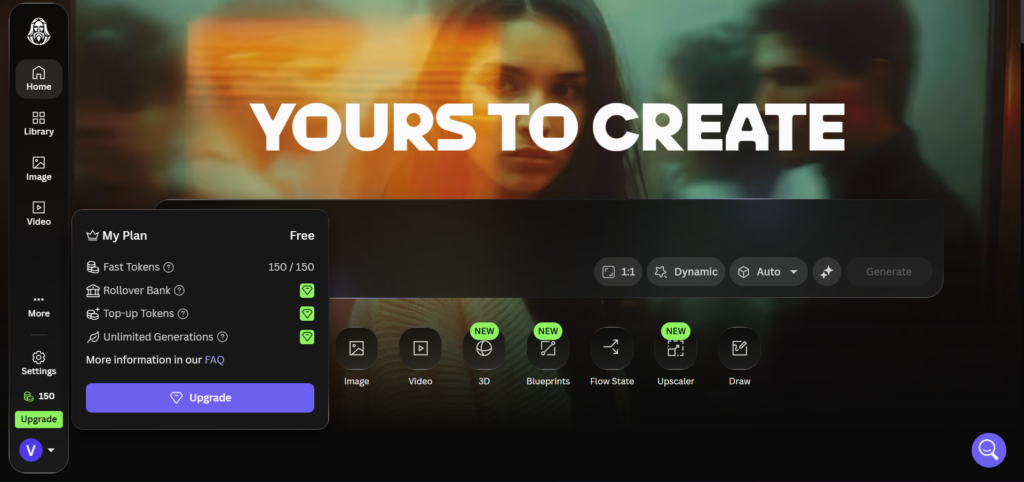
The free plan provides 150 tokens per day, resetting daily. Free plan images are public and visible in the community gallery. Private generation requires a paid plan starting at the Essential tier.
Free users receive access to community-created fine-tuned models, basic image generation at various resolutions, and the ability to explore the platform’s full feature set with some limitations. The free tier resets daily, so consistent casual use is sustainable without ever paying.
At 150 daily tokens, a standard image generation using the Leonardo Phoenix model at a common resolution costs approximately 4 to 8 tokens. That puts daily output at roughly 20 to 35 standard images, though activating features like Alchemy post-processing or higher resolutions pushes token cost per image upward and reduces daily output accordingly.
The practical ceiling matters. Activating the Alchemy Refiner can increase token consumption to 10 to 15 credits per image, reducing daily output to 10 to 15 images. If you opt for higher resolution or multiple image variations, those 150 tokens can disappear in a short session.
The key limitations on the free plan: all images are public, Leonardo AI retains ownership of the assets you create (though you receive a commercial use license), no custom LoRA model training, no token rollover, standard queue priority only, and no private generation mode. For a full breakdown of what the free plan includes and excludes, see our dedicated Leonardo AI free plan guide.
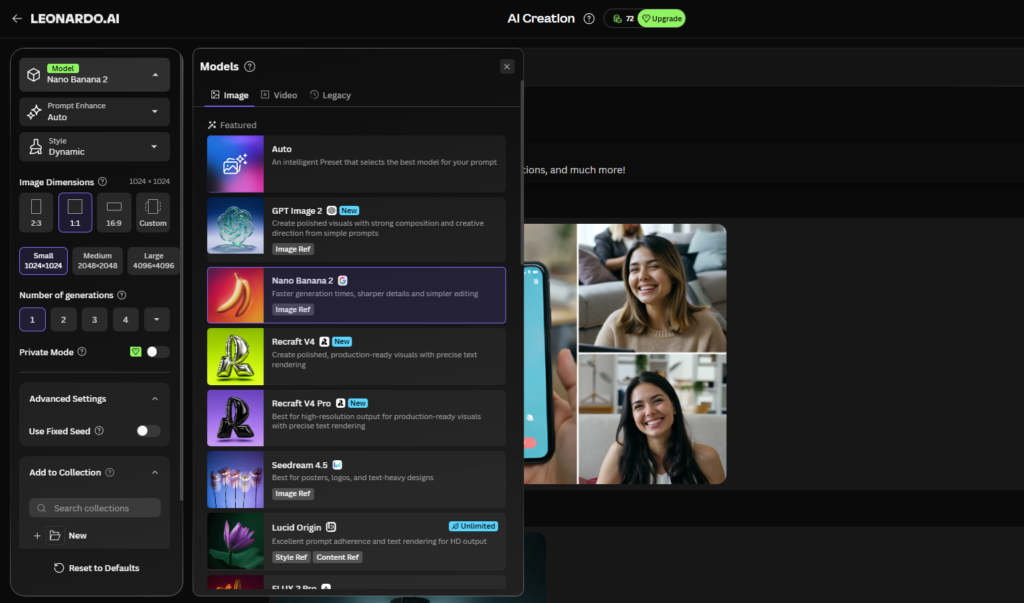
Essential Plan: $12 Per Month
The Essential plan costs $12 per month on monthly billing, or $10 per month when billed annually. This is Leonardo’s entry-level paid tier and was previously called the Apprentice plan.
What you get on the Essential plan:
- 8,500 tokens per month
- Private generation mode
- Full intellectual property ownership
- 1 LoRA training slot per month
- 2 concurrent generations
- Token rollover to the next billing cycle
- No watermarks on downloaded images
- Consistent Character Engine access
The real token math. The Essential plan unlocks 8,500 monthly tokens, Consistent Character Engine access, and 1 LoRA training per month. At this token level, the plan supports approximately 470 to 530 images per month — enough for personal use but tight for professional production.
The Consistent Character Engine adds roughly 25 percent to token cost per generation. If you use it frequently, your effective monthly image count drops closer to 350 to 420 before your tokens run out. Plan for this if character consistency is central to your workflow.
The single LoRA training slot per month means you get one custom model trained per billing cycle. If your first training does not produce good results and you need to retry with a different dataset, you wait until next month. For users who rely heavily on custom model training, this is a genuine constraint. Our Leonardo AI LoRA training guide covers how to prepare your dataset properly to avoid wasted training attempts.
Cost per image on Essential: At 8,500 tokens and standard generation settings, your cost per image works out to approximately $0.007. That is a reasonable rate for unique, custom AI-generated images compared to stock photography or commissioned illustration.
Who it is for: Bloggers, newsletter creators, students, hobbyists, and light freelancers who need private generations and full content ownership but produce images at a moderate monthly volume.
Premium Plan: $30 Per Month
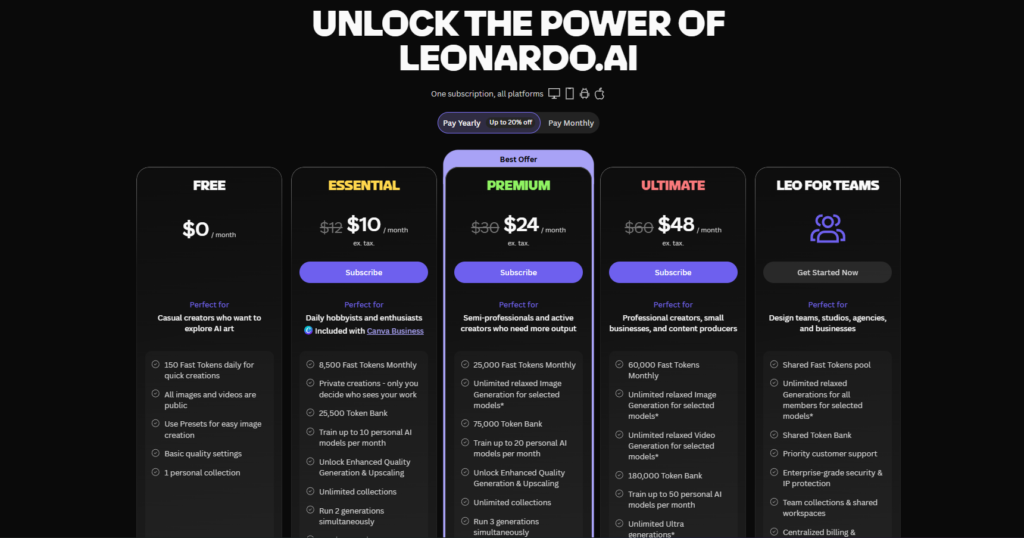
The Premium plan costs $30 per month on monthly billing, or $24 per month billed annually. This plan was previously called the Artisan plan and is the tier most professional creators will find offers the right combination of volume, features, and value.
What you get on the Premium plan:
- 25,000 tokens per month
- Private generation mode
- Full IP ownership
- 5 LoRA training slots per month
- 5 concurrent generations
- Priority generation queue
- Token rollover
- API access
- Unlimited relaxed generation on selected first-party models
Token math at this level. The Premium plan provides 25,000 tokens, supporting approximately 1,400 to 1,560 images per month at standard settings. The cost per image at this tier works out to roughly $0.02 — significantly cheaper than stock photography for unique, custom content.
The priority queue is a meaningful benefit during peak hours. Free and Essential plan users sit in a standard queue, while Premium users process ahead of them. During busy periods, this difference in wait time is noticeable.
API access is the feature that separates the Premium plan from the Essential tier for developers and teams with automated workflows. API access is the primary reason to upgrade from Essential. If you need to integrate Leonardo into a production pipeline, automate generation, or build tools on top of Leonardo’s capabilities, the API is essential. Note that API credits are a separate system from subscription tokens — more on that in the Teams and API section below.
About Unlimited Relaxed Generation. This feature sounds unlimited, but it comes with an important restriction. Third-party models including GPT-Image-1, Flux.1 Kontext, Ideogram, Nano Banana, Flux Kontext Max, Veo 3, Kling 2.5 Turbo, Kling 2.1 Pro, Sora 2, Sora 2 Pro, and others require tokens every time you use them, even on plans with unlimited relaxed generation. Relaxed generation only applies to first-party models like Phoenix 1.0, Lucid Origin, Lucid Realism, and first-party motion models. The most in-demand premium integrations always cost fast tokens.
5 LoRA training slots per month allow you to develop and iterate on custom models for multiple projects within a single billing cycle. Train a style model, evaluate it, adjust your reference dataset, and retrain without waiting for a new month. This is the combination that makes the Premium plan feel built for professional workflows rather than casual use.
If you want to understand how this plan fits into specific creative fields, our guides on Leonardo AI for marketing and Leonardo AI for game developers cover the practical setup in detail.
Who it is for: Working freelancers, marketing professionals, small studios, indie game developers, and content creators who need consistent high-volume output with full ownership, API access, and custom model flexibility.
Ultimate Plan: $60 Per Month
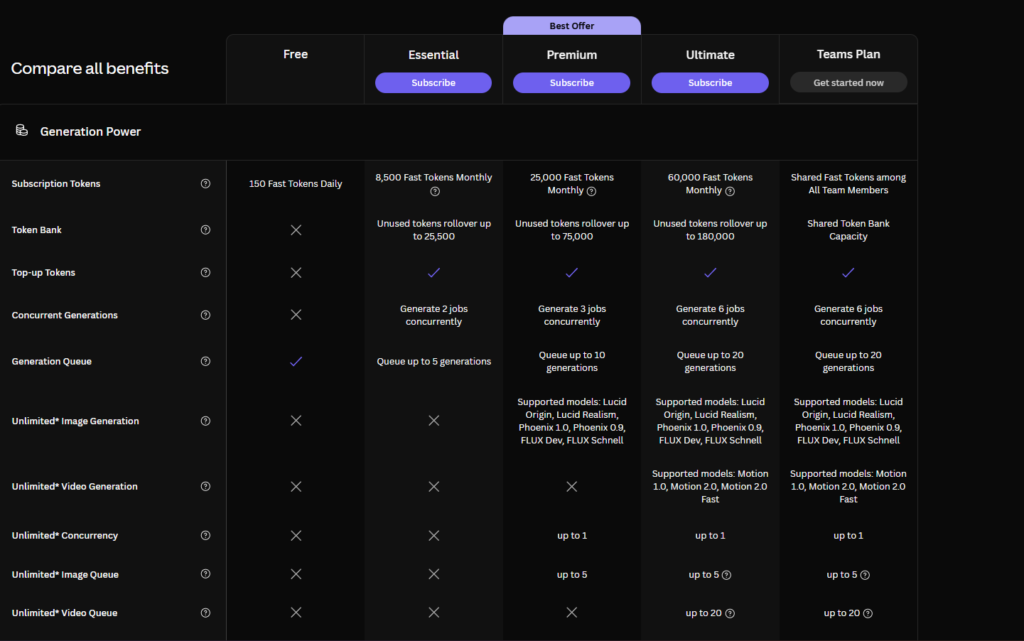
The Ultimate plan costs $60 per month on monthly billing, or $48 per month billed annually. This is Leonardo’s highest consumer-facing tier, previously called the Maestro plan.
What you get on the Ultimate plan:
- 60,000 tokens per month
- Private generation mode
- Full IP ownership
- 20 LoRA training slots per month
- 10 concurrent generations
- Maximum priority queue
- Token rollover
- API access
- Unlimited relaxed generation on selected first-party models including video
Token math at this level. The Ultimate plan’s 60,000 tokens support approximately 3,300 to 3,750 images per month — enough for team use or high-volume individual production. Twenty LoRA training slots enable rapid iteration across multiple projects simultaneously.
The Maestro plan at $48 per month annually offers the lowest per-credit cost across all tiers, ranging from approximately $0.004 to $0.0096 per image depending on features used. For high-volume users, this per-image economics argument is compelling. At $0.004 per image with simple settings, you are generating at a cost that makes almost any creative production workflow financially sensible.
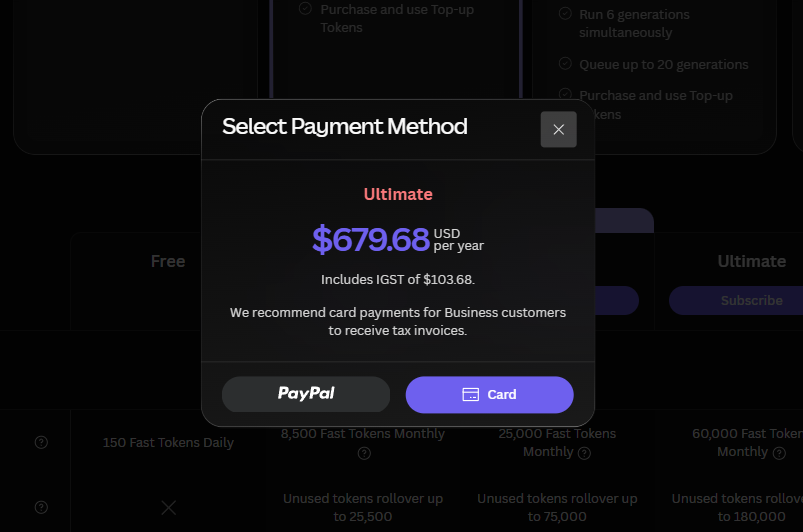
The honest question is whether most solo professionals actually need this tier. The Ultimate plan makes sense for teams of two to four people sharing an account, or individual power users generating at very high volume. For most professionals, the Premium plan provides sufficient capacity. The practical decision rule: if you are consistently exhausting your Premium plan tokens before month end, upgrade. If you are not hitting that ceiling, the Ultimate plan is overhead you do not need.
Teams and API Pricing
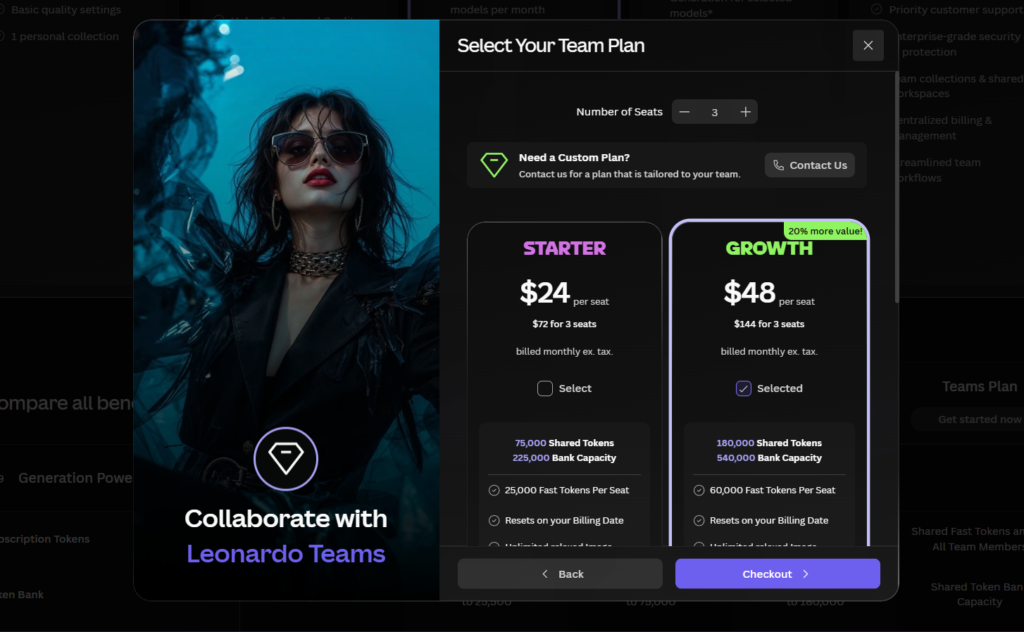
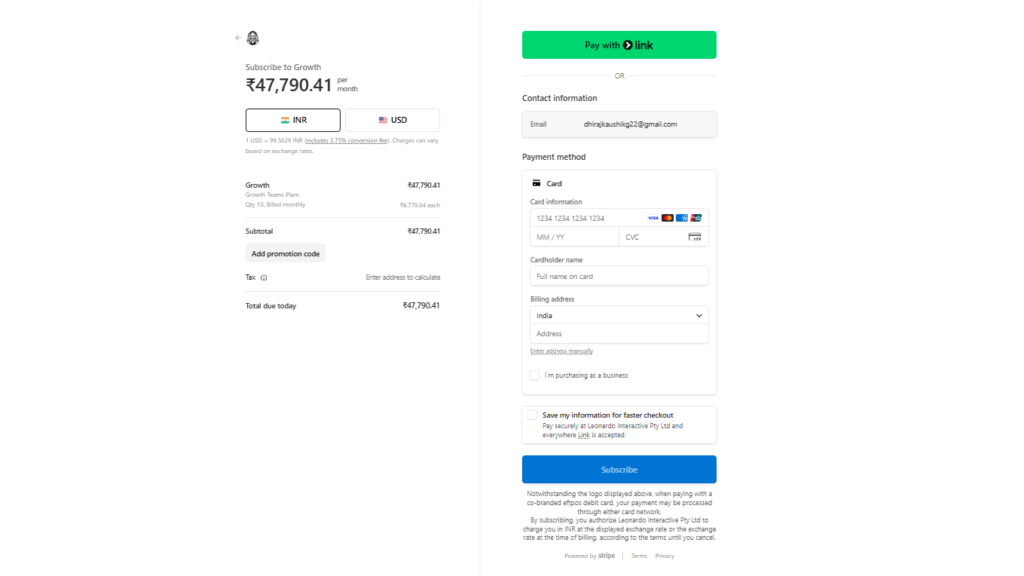
Teams pricing starts at $24 per seat per month. Team plans include shared token packages and collaboration features that scale with agency and studio needs. Teams plans sit outside the individual subscription structure and are designed for workspaces where multiple members need shared project access, generation history, and admin controls.
API pricing is entirely separate from subscription tokens. Your monthly subscription tokens cannot be used for API calls. The API operates on its own credit system, and new users receive $5 in free API credit to test integrations before spending anything. API access starts at $9 per month for 3,500 credits under the Basic tier, using a separate credit system priced differently from standard subscription tokens.
The API also now supports a Pay-As-You-Go model for existing subscribers who want to move away from fixed monthly API commitments. You load credit in amounts you choose, and the pricing calculator inside the platform lets you estimate the cost of any generation configuration before running it at scale. This is practical for developers who want cost predictability without a minimum monthly commitment.
Manual token top-up packs are available if you exhaust your monthly subscription pool before reset. Video generation is extremely token-intensive — one 5-second Veo 3 clip costs 2,500 fast tokens. This is worth knowing before relying on top-ups to cover video generation costs. Our Leonardo AI video generation guide covers this cost dynamic in full detail.
Annual vs Monthly Billing: Exact Savings
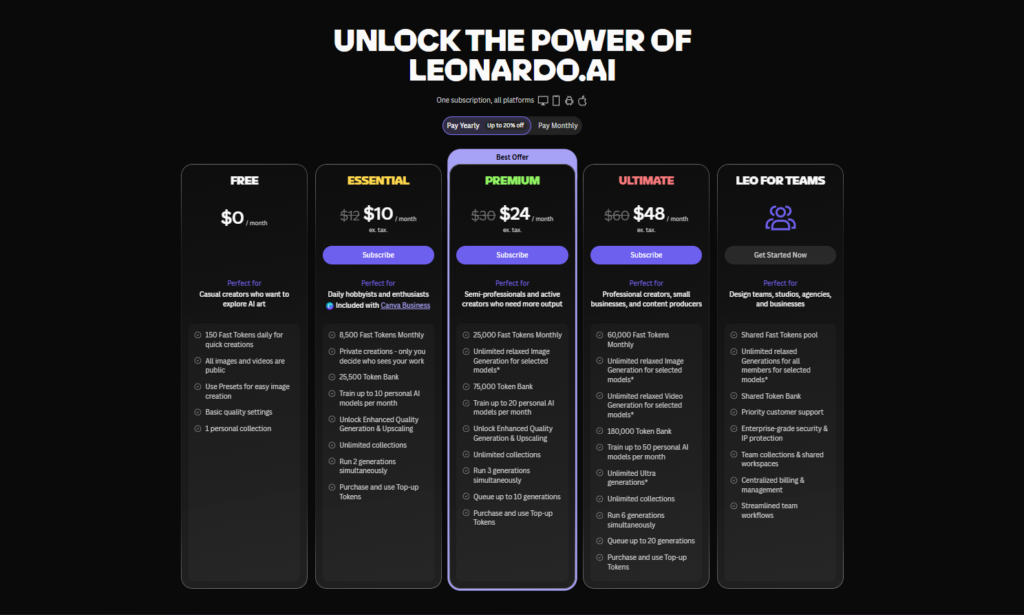
Annual billing saves approximately 20 percent across all paid plans. Here is exactly what that means in numbers:
| Plan | Monthly Billing | Annual Billing | Annual Total | You Save |
|---|---|---|---|---|
| Essential | $12/month | $10/month | $120/year | $24/year |
| Premium | $30/month | $24/month | $288/year | $72/year |
| Ultimate | $60/month | $48/month | $576/year | $144/year |
The break-even point on annual billing versus monthly is approximately five months. If you have validated your workflow through the free plan or a month or two on a monthly subscription and are confident you will use Leonardo AI consistently for six months or more, the annual commitment is worth making. The $72 saving on the Premium plan alone is equivalent to three months of the Essential plan.
One practical note: Leonardo does not offer free trials for paid plans. The recommendation is to spend at least a month on monthly billing to understand your actual token consumption pattern before switching to annual billing. Refunds on annual plans are assessed manually, so treating the first month as your evaluation period on monthly billing is the lower-risk approach.
Hidden Costs That Catch People Out
Video generation is far more token-expensive than image generation. A 5-second clip using Veo 3 costs 2,500 fast tokens per generation. On the Essential plan’s 8,500 monthly tokens, a single video clip uses 29 percent of your entire monthly budget. On the Premium plan, each clip costs 10 percent of your monthly tokens. If video is part of your workflow, either budget very carefully or evaluate whether Leonardo’s integrated video tools are the right choice for that specific use case.
Alchemy post-processing doubles or triples token cost per image. Using the Alchemy Refiner can increase credit consumption to 10 to 15 tokens per image, compared to 4 to 6 for a standard generation. Users who enable Alchemy on every generation will exhaust their monthly pool substantially faster than the headline token count suggests. Use Alchemy on final renders rather than exploratory generations to preserve your token balance.
Third-party model integrations always cost fast tokens. Third-party models including Veo 3, Flux.1 Kontext, Ideogram, Kling 2.5 Turbo, and others always consume fast tokens regardless of your plan tier. The Unlimited Relaxed Generation feature on Premium and Ultimate plans does not apply to these models. Treating that feature as genuinely unlimited is the most common misunderstanding in Leonardo AI pricing, and it leads to unexpected token depletion.
Token top-ups are available but expensive per token. If you exhaust your monthly pool, you can purchase additional fast tokens without upgrading. These top-up packs cost more per token than the equivalent within your subscription. If you find yourself buying top-ups more than once per month, upgrading your plan tier is almost always more cost-effective than continuing with top-ups.
The Consistent Character Engine adds to every generation cost. This feature adds approximately 25 percent to the token cost of each image it is applied to. If character consistency is central to your workflow, factor this into your plan selection rather than discovering it after you have already committed.
Which Leonardo AI Plan Should You Choose?
Stay on the free plan if you are evaluating the platform, generating for personal use without confidentiality requirements, and your creative output fits comfortably within 150 tokens per day. The free plan is a genuine permanent tier, not a limited trial.
Choose the Essential plan at $12 per month if you need private generations, full IP ownership, and the Consistent Character Engine for consistent creative work. You produce a moderate volume of images, client work is occasional rather than daily, and one LoRA training slot per month is enough for your current projects.
Choose the Premium plan at $30 per month if you are a working professional who generates images regularly for clients, marketing, game development, or content production. The API access, 5 LoRA training slots, priority queue, and 25,000 monthly tokens make this the most complete professional tier at a price point that is justifiable for regular commercial use. For professional creators, the Premium plan is where Leonardo AI becomes a production tool rather than a creative experiment.
Choose the Ultimate plan at $60 per month if you or your team consistently exhaust Premium tokens before month end, or if you need 20 LoRA training slots and maximum queue priority for agency-level throughput. Most individual creators will not need to reach this tier.
How Leonardo AI Pricing Compares to Competitors?
| Tool | Free Plan | Entry Paid | Mid Tier | Top Consumer Tier | Custom Training |
|---|---|---|---|---|---|
| Leonardo AI | 150 tokens/day | $12/mo (8,500 tokens) | $30/mo (25,000 tokens) | $60/mo (60,000 tokens) | Yes, from Essential |
| Midjourney | None | $10/mo | $30/mo | $60/mo | No |
| Adobe Firefly | 25 credits/month | From $9.99/mo (Creative Cloud) | From $59.99/mo | Enterprise (custom) | No |
| DALL-E 3 | Limited via ChatGPT Free | $20/mo (ChatGPT Plus) | — | — | No |
| Stable Diffusion | Free (self-hosted) | Cloud from ~$10/mo | Varies | Varies | Yes (technical setup) |
Paid plan subscribers have commercial usage rights for images generated under their account. Free plan images are public and may carry additional restrictions. Always review the current Terms of Service for your specific plan before publishing or selling AI-generated content.
The sharpest comparison is with Midjourney. At identical price points, Leonardo AI includes custom model training, a full editing canvas, character consistency tools, API access on mid-tier plans, and a free plan. Midjourney offers none of these. What Midjourney does offer is a default artistic aesthetic that many users find more visually striking with minimal prompting effort. The two tools genuinely suit different working styles. For a side-by-side analysis of every meaningful difference, see our Leonardo AI vs Midjourney comparison.
Backlink Opportunities
| S.No | Site | Angle |
|---|---|---|
| 1 | G2 Learn Hub — learn.g2.com | Cite as reference in their Leonardo AI pricing comparison updates |
| 2 | Capterra Blog — capterra.com/blog | Software pricing breakdowns — pitch your 2026 token math as a credible data source |
| 3 | HubSpot Blog — blog.hubspot.com | Target “best AI tools for marketers” and “free AI image generators” roundups |
| 4 | Creative Bloq — creativebloq.com | Guest pitch: AI tool pricing for designers in 2026 |
| 5 | MakeUseOf — makeuseof.com | “Is Leonardo AI worth paying for in 2026” guest post pitch |
| 6 | TechRadar — techradar.com | Submit as cited resource in AI image generator roundups |
| 7 | Blogging Wizard — bloggingwizard.com | Targets creators evaluating tools — pricing guides fit their audience perfectly |
| 8 | SitePoint — sitepoint.com | Community article pitch on AI tool token cost comparisons |
| 9 | Tooltester — tooltester.com | Software comparison site that links to in-depth pricing resources |
| 10 | Elegant Themes Blog — elegantthemes.com/blog | WordPress creator audience — AI tool cost guides are a strong fit |
Frequently Asked Questions
What are the current Leonardo AI plan names in 2026?
Leonardo AI’s individual subscription tiers in 2026 are Free, Essential, Premium, and Ultimate. These replaced the earlier names of Apprentice, Artisan, and Maestro that the platform used through 2025. The pricing and token allocations at each level have remained consistent through this rename. Essential is $12 per month, Premium is $30 per month, and Ultimate is $60 per month on monthly billing. Annual billing reduces each to $10, $24, and $48 per month respectively. Always verify current plan names and prices at the official pricing page before subscribing, as Leonardo has updated its naming structure more than once.
Do Leonardo AI tokens roll over if unused?
On the free plan, tokens do not roll over. Daily tokens reset every 24 hours and cannot be saved or accumulated. On all paid plans (Essential and above), Leonardo AI includes a Token Rollover feature that carries unused tokens into the next billing cycle via a Rollover Bank. The maximum rollover balance varies by plan. This makes paid plans more forgiving for users whose generation volume fluctuates significantly from week to week. Token top-up packs purchased separately never expire and are not subject to rollover limits.
Is the Unlimited Relaxed Generation on Premium and Ultimate actually unlimited?
Only partially. Relaxed Generation lets you continue generating after your fast token pool runs out, but it only applies to selected first-party models. These currently include Lucid Origin, Lucid Realism, Phoenix 1.0, Phoenix 0.9, Motion 1.0, Motion 2.0, and Motion 2.0 Fast. Premium third-party integrations such as Veo 3, Flux.1 Kontext, Ideogram, Kling, and Sora models always require fast tokens and cannot be used in relaxed mode. Relaxed generation also runs at a lower priority queue with reduced concurrency, so it is noticeably slower during peak hours. The unlimited label is accurate for basic first-party models but does not extend to the most premium features.
Does Leonardo AI include API access in its standard subscriptions?
API access is included starting from the Premium plan. Essential plan subscribers do not have API access. Importantly, the API uses a separate credit system from your subscription tokens. Your monthly subscription tokens cannot be used for API calls. API credits are purchased separately on a pay-as-you-go basis, with new API accounts receiving $5 in free credit to test integrations. The API Basic subscription starts at $9 per month for 3,500 API credits. If you are building programmatic workflows, factor API credit costs separately from your subscription fee.
Can I use Leonardo AI images commercially on every plan?
On paid plans (Essential and above), you retain full ownership and intellectual property rights, and you receive a commercial license covering client work, marketing materials, products, and publications. On the free plan, Leonardo AI retains ownership of the assets you create, and all images are publicly visible in the community gallery. You do receive a non-exclusive commercial use license even on the free plan, meaning you can technically use free-plan images in commercial projects. However, since those images are public, other users can also access and use them. For exclusive commercial work, a paid plan is the only appropriate choice.
How do I avoid running out of tokens too quickly?
The most effective habits are: avoid enabling Alchemy post-processing on every generation — save it for final renders rather than exploratory passes; check the token cost on the Generate button before confirming high-resolution or multi-variation generations; use Flux Schnell for quick concept iterations since it costs fewer tokens per image than premium models; and limit video generation on lower-tier plans since a single 5-second Veo 3 clip costs 2,500 fast tokens. Generating 4 image variations in a single batch rather than four separate single-image generations often costs the same or less per image and gives you comparison options more efficiently.
Final Thoughts
Leonardo AI pricing in 2026 is straightforward once you understand the token system and what actually changes between tiers. The free plan works for evaluation and casual personal use. The Essential plan solves the two biggest free-tier friction points — public images and ownership — at a low monthly cost. The Premium plan is where the platform earns its position as a professional tool, with API access, LoRA training at a useful volume, and enough tokens for consistent commercial production. The Ultimate plan is for agencies and power users who have genuinely outgrown the Premium tier.
The hidden costs around video, Alchemy, and third-party model token consumption are the details worth understanding before committing. A week on the free plan watching which features you actually reach for will tell you more about which paid tier suits you than any comparison article, including this one.
Check the current plan details at leonardo.ai/pricing before subscribing, and review our complete Leonardo AI guide if you want to understand the platform’s full capabilities before choosing a tier.