I picked one prompt, kept it word-for-word identical, and ran it through both platforms back to back. Indie rock ballad, emotional female vocals, fingerpicked acoustic guitar, atmospheric reverb, melancholic mood building to a powerful chorus. The results told me more in five minutes than any spec sheet comparison could. But the real story here is not which platform sounds better. It is what happened to Udio’s entire business model in October 2025, and why that single event now matters more to your decision than any audio quality difference.
Table of Contents
The Same Prompt, Two Platforms: What I Heard
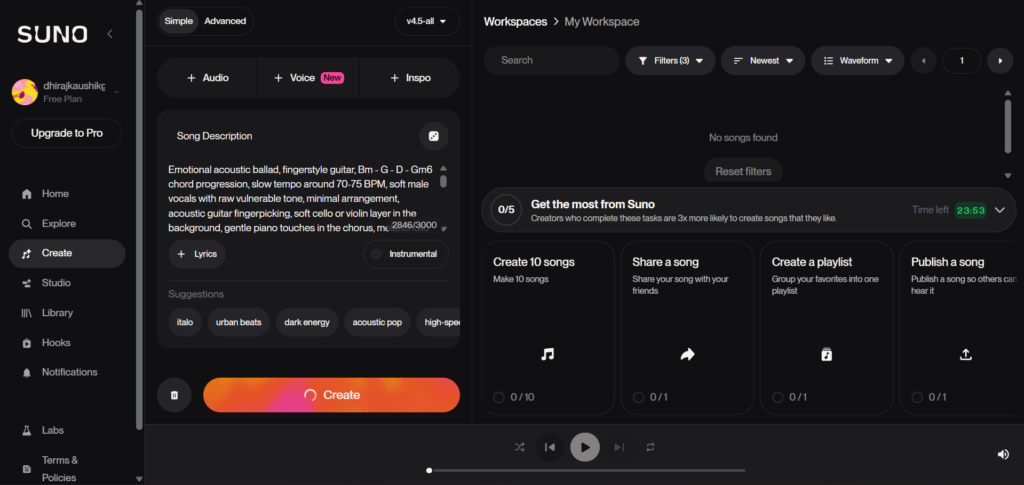
I used one test prompt across both: indie rock ballad, emotional female vocals, fingerpicked acoustic guitar, atmospheric reverb, melancholic mood, building to a powerful chorus. No edits, no platform-specific tweaks, the exact same words submitted to each.
Suno’s result delivered what I can only describe as unrivaled emotional delivery in the vocals. The chorus felt earned in a way that surprised me, with natural vibrato and the kind of breathy imperfection that makes a vocal performance sound human rather than synthesized. Udio’s result took a different shape entirely. The acoustic guitar sounded indistinguishable from a live recording, and the overall mix was wide and professional in a way that genuinely impressed me on headphones, but the vocal performance felt comparatively flatter and less emotionally specific.
That single test mirrors what I found across dozens of additional generations on both platforms over several weeks: Suno wins on vocal emotion and finished song quality, Udio wins on instrumental clarity and mix width. Neither platform loses badly at the other’s strength, the gap is narrower than either company’s marketing suggests, but the gap is consistent and repeatable across genres.
If you have not yet spent real time inside Suno specifically, our complete Suno AI review covers 60 generated tracks and the platform’s full feature set in depth, which is useful context before diving into this direct comparison.
The Single Decision That Matters Most: Can You Get Your Song Out?
This is the section that decides the comparison for most people, and it has nothing to do with how either platform sounds.
In October 2025, Universal Music Group settled its copyright lawsuit with Udio and announced a strategic licensing partnership. As part of that deal, Udio disabled downloading of audio, video, and stems entirely. It is now a streaming-only platform where you can play your creations inside the app but cannot export or distribute them anywhere else. Udio gave existing users a 48-hour window to download songs made under the old terms. Anything generated after that window lives permanently inside Udio’s walled garden.
Suno took a meaningfully different path. Suno settled with Warner Music Group in November 2025 and tightened its own terms in response, but it kept downloads available for paying subscribers, with monthly caps tied to your plan tier. You still get stems, you still get a path toward MIDI export through Suno Studio, and you still walk away from a session with an actual audio file you own and can use.
The practical consequence: if your plan is to generate a song, listen to it, and keep it inside a polished app purely for personal enjoyment, both platforms work equally well and the decision genuinely comes down to which one sounds better to your ear. If you want to do anything with the song afterward, release it, hand it to a band, upload it to YouTube, sync it to a video, Suno is currently the only practical choice between the two. Our Suno AI pricing guide breaks down exactly which tier you need to unlock those download and commercial rights, since the free plan on either platform restricts you to personal, non-commercial use only.
Vocal Quality: Where Suno Pulls Ahead
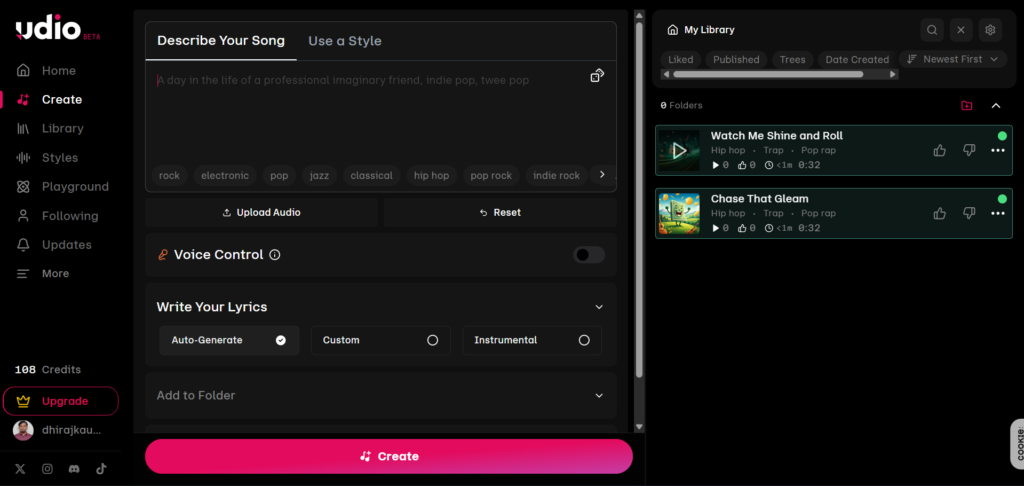
Suno v5.5 has the most natural-sounding vocals of any current AI music generator. Pop, rock, country, and R&B all come out with realistic vocal delivery, vibrato, and emotional phrasing that genuinely closes the gap between “obviously AI” and “could pass for a real recording” in many cases.
The jump from earlier Suno versions to v5 specifically was dramatic. The robotic quality that plagued earlier releases is mostly gone, replaced by vocals that carry natural breath, vibrato, and phrasing closer to an actual human singer. If your work leans vocal-heavy, pop, R&B, singer-songwriter material, Suno wins this category clearly and consistently across the genres I tested.
Udio’s vocals are capable but more inconsistent, particularly on longer generations, where quality can drift as the track extends past the first minute or so. Udio holds its own and occasionally surprises in genres outside straightforward pop structure, with hip-hop, ambient, and electronic textures sometimes producing more unexpected, interesting vocal character than Suno’s more polished, radio-shaped output.
Suno also offers voice cloning through its Voices feature on the Pro tier, allowing you to capture and reuse your own singing voice across generations, a capability Udio does not currently match. For creators building a consistent recurring vocal identity across multiple tracks, this is worth knowing, and it pairs naturally with Suno’s Personas feature for maintaining consistency project to project.
Instrumental Fidelity: Where Udio Still Wins?
Udio is the undisputed leader on pure instrumental separation and mix fidelity. By outputting at 48kHz compared to Suno’s 44.1kHz, Udio delivers a professional mix where every snare hit and synth layer feels distinct and wide, the kind of separation that producers specifically reach for when instrumental clarity matters more than vocal performance.
Industry reviewers consistently rate Udio’s instrumental output as almost indistinguishable from real recordings in terms of sound fidelity, particularly for genres without vocals at all, electronic music, ambient textures, cinematic backing, and hip-hop beats, where Udio often produces more interesting and varied results than Suno’s comparatively more structured approach.
For marketing and content use cases specifically, this split plays out practically. Udio excels at clean instrumental production for webinars, product demos, and presentation soundtracks, since spoken narration paired with Suno’s vocal-forward output creates an unwanted distraction that a clean instrumental bed avoids entirely. If you are building background music for a YouTube channel where viewers are also listening to your own voiceover, Udio’s instrumental specialization solves a real problem Suno was never designed to solve. Our guide on using Suno for YouTube content covers this specific tension in more detail, including when Suno’s instrumental-only mode is the better internal choice over reaching for Udio at all.
Track Length and Generation Speed
Suno generates a complete track in approximately 30 seconds, making it genuinely ideal for rapid prototyping and sketching out song ideas quickly. Udio takes closer to 90 seconds per generation, prioritizing complex architectural layering over raw speed, which tends to make it the better tool for working toward a finished product rather than quick iterative drafts.
On maximum track length, the two platforms diverge in an interesting way. Udio’s native generation length is shorter at 32 seconds, but it extends cleanly to 15 minutes while maintaining consistent style and progression throughout. Suno’s native length runs to 4 minutes and extends to roughly 10 minutes, but extensions can noticeably drift stylistically once you push past the 6-minute mark.
The practical takeaway: for standard 3 to 5 minute songs, the format most creators actually need, Suno is the more reliable choice. For long-form ambient, cinematic, or continuous mix work where consistency across an extended runtime matters more than speed, Udio’s extension architecture currently has the edge.

Instrumental Fidelity: Where Udio Still Wins?
Udio is the undisputed leader on pure instrumental separation and mix fidelity. By outputting at 48kHz compared to Suno’s 44.1kHz, Udio delivers a professional mix where every snare hit and synth layer feels distinct and wide, the kind of separation that producers specifically reach for when instrumental clarity matters more than vocal performance.
Industry reviewers consistently rate Udio’s instrumental output as almost indistinguishable from real recordings in terms of sound fidelity, particularly for genres without vocals at all, electronic music, ambient textures, cinematic backing, and hip-hop beats, where Udio often produces more interesting and varied results than Suno’s comparatively more structured approach.
For marketing and content use cases specifically, this split plays out practically. Udio excels at clean instrumental production for webinars, product demos, and presentation soundtracks, since spoken narration paired with Suno’s vocal-forward output creates an unwanted distraction that a clean instrumental bed avoids entirely. If you are building background music for a YouTube channel where viewers are also listening to your own voiceover, Udio’s instrumental specialization solves a real problem Suno was never designed to solve. Our guide on using Suno for YouTube content covers this specific tension in more detail, including when Suno’s instrumental-only mode is the better internal choice over reaching for Udio at all.
Track Length and Generation Speed
Suno generates a complete track in approximately 30 seconds, making it genuinely ideal for rapid prototyping and sketching out song ideas quickly. Udio takes closer to 90 seconds per generation, prioritizing complex architectural layering over raw speed, which tends to make it the better tool for working toward a finished product rather than quick iterative drafts.
On maximum track length, the two platforms diverge in an interesting way. Udio’s native generation length is shorter at 32 seconds, but it extends cleanly to 15 minutes while maintaining consistent style and progression throughout. Suno’s native length runs to 4 minutes and extends to roughly 10 minutes, but extensions can noticeably drift stylistically once you push past the 6-minute mark.
The practical takeaway: for standard 3 to 5 minute songs, the format most creators actually need, Suno is the more reliable choice. For long-form ambient, cinematic, or continuous mix work where consistency across an extended runtime matters more than speed, Udio’s extension architecture currently has the edge.
The Legal Picture: Litigation vs Licensed
Understanding where each platform stands legally matters more for AI music than for almost any other generative AI category right now, because the underlying training-data lawsuits are still actively shaping what each company is allowed to let you do with your output.
Suno settled with Warner Music Group in November 2025 but remains in active litigation with Sony Music as of mid-2026. A pivotal fair-use ruling in that case is expected around a confirmed July 2026 summary-judgment hearing, a ruling that could establish AI-training liability standards for the entire generative AI industry, not just music specifically. Until that ruling lands, the legal ground under Suno continues shifting, and Suno’s own terms explicitly avoid guaranteeing that copyright vests cleanly in your generated output.
Udio took the opposite path entirely. Its October 2025 settlement with Universal Music Group closed cleanly, and Udio has since signed similar licensing agreements with Warner Music, Merlin, and Kobalt through the first quarter of 2026. A jointly licensed UMG-Udio platform, built on authorized and compensated training data with filtering to prevent unauthorized reproduction, is scheduled to launch under the existing Udio name sometime in 2026. That is a genuine first for the AI music industry: a platform where the underlying rights holders are actually compensated when their material contributes to training, rather than a defendant arguing fair use after the fact.
The blunt summary: in mid-2026, Udio is the platform with the cleaner licensing story but no way to get your song off the platform, and Suno is the platform you can actually release from while a consequential Sony verdict still looms. Our complete legal and commercial use guide for Suno goes deeper into exactly what this active litigation means for your specific risk tolerance depending on whether you are a hobbyist, a content creator, or running commercial client work.
One more important point worth knowing regardless of which platform you choose: in the United States, a track generated purely from a prompt with no added human authorship is not currently registrable for copyright protection, a position courts have upheld through 2026. Adding your own lyrics, a recorded performance, or genuine arrangement work on top of either platform’s output is what creates something you can actually protect and claim ownership over.
How Working Producers Actually Use Both Together?
The most experienced workflow I encountered while researching this, echoed by multiple working producers, treats Suno and Udio as complementary rather than competing tools rather than forcing a single winner.
The practical pattern looks like this: generate a batch of quick ideas on Udio first, since its faster architectural layering and instrumental strength surface interesting structural starting points quickly. Pick the strongest concept, then regenerate something structurally similar on Suno specifically for better vocal quality and Suno’s more reliable standard-length song structure. Export the stems from Suno, since that export path is the one that actually works, and finish the real mixing and mastering work in a traditional DAW.
This dual-tool approach treats AI generation as a replacement for the blank page, not as a replacement for the production process itself. If you are exploring Suno Studio specifically as part of that final production stage, our hands-on Suno Studio review covers exactly what the multitrack editing environment can and cannot reliably do once you have your exported stems in hand.
For a catalog builder working across multiple revenue channels, owning both subscriptions covers more creative ground than committing to either platform exclusively, particularly given how cleanly their respective strengths divide between vocal-led songs and instrumental beds.
Full Comparison Table
| Feature | Suno (v5.5) | Udio (1.5) |
|---|---|---|
| Vocal quality | Most natural in category, voice cloning available | Capable but inconsistent on longer tracks |
| Instrumental fidelity | Strong, 44.1kHz | Best in category, 48kHz, wider mix |
| Generation speed | ~30 seconds | ~90 seconds |
| Native track length | Up to 4 minutes, extends to ~10 | 32 seconds, extends cleanly to 15 minutes |
| Downloads/export | Yes, on paid tiers with monthly caps | No, disabled platform-wide since Oct 2025 |
| Commercial rights | Yes, Pro tier and above | Yes on paper, but unusable without export |
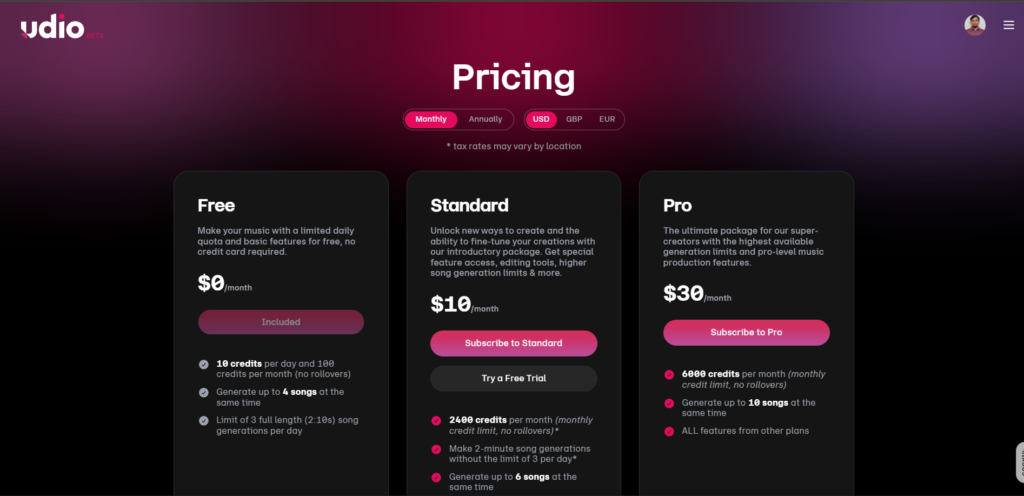
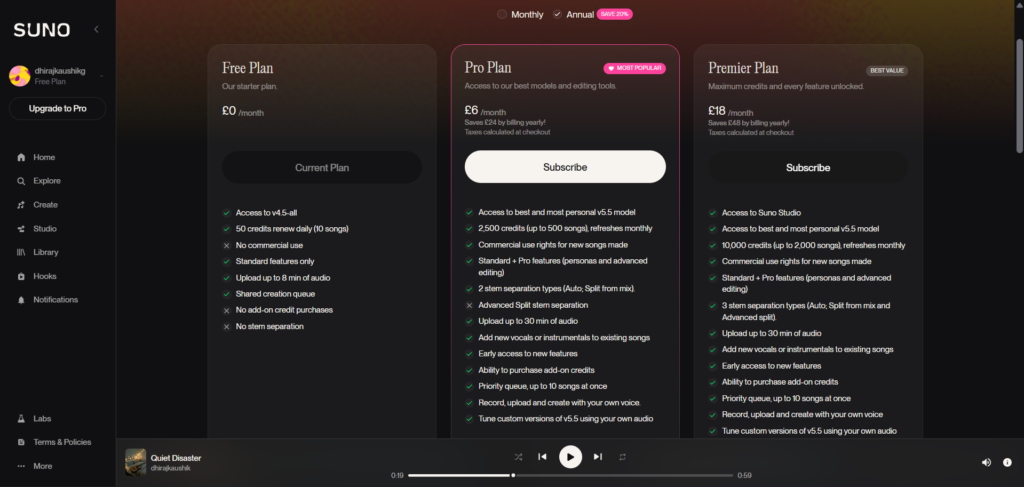
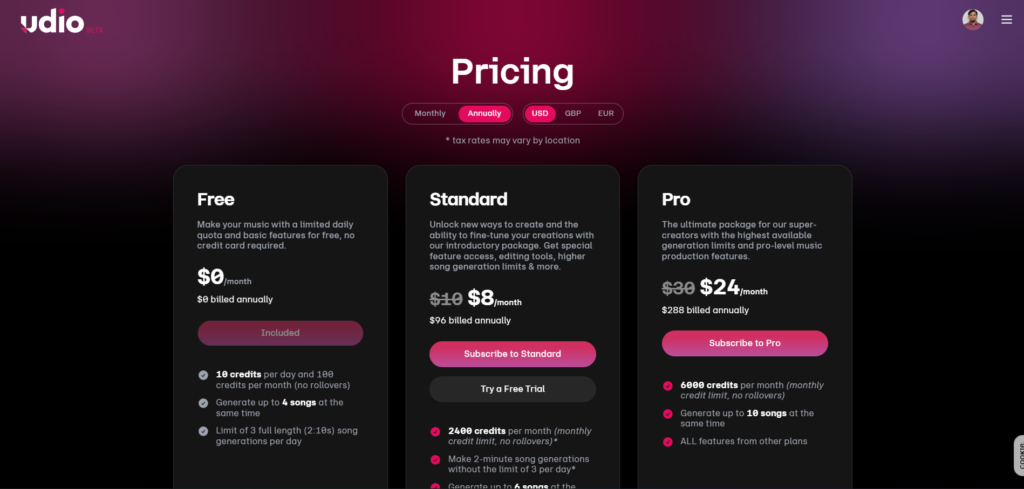
| Free tier | Yes, non-commercial only | Yes, 10 credits/day + 100/month, non-commercial |
| Pro tier price | $8-10/month | $10/month |
| Top tier price | $24-30/month (Premier, includes Studio) | $30/month |
| Legal status | Warner settled, Sony litigation active, July 2026 ruling expected | UMG, Warner, Merlin, Kobalt all settled and licensed |
| Best genre fit | Pop, R&B, singer-songwriter, vocal-led songs | Electronic, ambient, hip-hop beats, instrumental backing |
| Stem/MIDI export | Yes, especially via Premier’s Studio | No, walled garden |
Who Should Choose Suno, Who Should Choose Udio?
Choose Suno if you need a finished, vocal-led song you can actually download and release, you want commercial rights at the lower entry price, and you are comfortable accepting some ongoing legal uncertainty while the Sony litigation works through the courts. This covers the overwhelming majority of US content creators, YouTubers, and songwriters who need an actual usable file at the end of the process.
Choose Udio if you specifically need clean, professional instrumental backing for marketing content, product demos, or webinar soundtracks where a vocal performance would distract from your own narration, and you genuinely do not need to export the track anywhere, you are comfortable keeping it inside Udio’s app for in-platform listening only.
Choose both if you are building a serious catalog across multiple use cases and the combined roughly $20 to $40 monthly cost across both Pro tiers is justifiable against the value of having instrumental strength and vocal strength both available without compromise. For a beginner just starting to explore this space without committing to either subscription yet, our Suno AI beginners guide is the right starting point before deciding whether a second platform is even necessary for your goals.
FAQ
Can I download my songs from Udio in 2026?
No, not for any song generated after October 2025. Following Udio’s settlement with Universal Music Group, the platform disabled downloading of audio, video, and stems entirely, becoming a streaming-only walled garden where creations live inside the app permanently. Udio gave existing users a 48-hour window to download songs made under the old terms before this change took effect. If you need to export and use your music anywhere outside the Udio app itself, including uploading to YouTube, releasing on streaming platforms, or using it in any video or commercial project, Suno is currently the only one of the two platforms that supports that workflow on paid tiers.
Which platform has better vocals, Suno or Udio?
Suno, and the gap is consistent across genres in direct testing. Suno’s v5.5 model produces the most natural-sounding vocals of any current AI music generator, with realistic vibrato, breath, and emotional phrasing that frequently closes the gap with genuine human performance, particularly in pop, R&B, and singer-songwriter material. Udio’s vocals are capable and occasionally produce interesting, unexpected character in genres like ambient or hip-hop, but quality becomes noticeably more inconsistent on longer generations. If vocal performance is the deciding factor for your specific project, Suno is the stronger choice in 2026.
Is Udio’s instrumental quality really better than Suno’s?
Yes, on pure technical fidelity. Udio outputs at 48kHz compared to Suno’s 44.1kHz, producing a wider, more professionally separated mix where individual instrument layers feel more distinct. Industry reviewers consistently describe Udio’s instrumental output, particularly for genres without vocals, as close to indistinguishable from real studio recordings. This makes Udio the stronger pick specifically for marketing content, webinar backgrounds, and product demo soundtracks where clean instrumental backing matters more than vocal performance and where a vocal-led track would distract from your own narration.
Is Suno facing an active lawsuit in 2026?
Yes. Suno settled with Warner Music Group in November 2025, but remains in active litigation with Sony Music as of mid-2026, with a pivotal fair-use summary-judgment hearing confirmed for July 2026. That ruling carries significance well beyond music specifically, since it will help establish whether training AI models on copyrighted material qualifies as fair use, a question with implications across text, image, and code generation as well. Until that case resolves, Suno’s own terms of service do not guarantee that copyright vests cleanly in songs you generate, so the legal ground for commercial use carries genuine, ongoing uncertainty that careful creators and agencies should factor into higher-stakes projects.
Has Udio settled all of its copyright lawsuits?
Largely yes, which is the core trade-off that defines the entire Suno versus Udio decision in 2026. Udio settled with Universal Music Group in October 2025 and has since signed similar licensing agreements with Warner Music, Merlin, and Kobalt through the first quarter of 2026. A jointly licensed UMG-Udio platform built on authorized, compensated training data is scheduled to launch under the Udio name sometime in 2026. The cost of this cleaner legal position is the walled garden restriction: in exchange for the licensing deals, Udio disabled all downloads, meaning the legal clarity does not currently translate into a usable export for creators who need the actual file.
Should I use Suno and Udio together instead of choosing just one?
Many working producers do exactly this, and it is a genuinely sound strategy if the combined cost fits your budget. A common workflow generates quick exploratory ideas on Udio first, since its faster layering and instrumental strength surface interesting structural starting points efficiently, then regenerates the strongest concept on Suno specifically for better vocal quality and a more reliable standard song structure, before exporting Suno’s stems into a traditional DAW for final mixing. This treats both tools as complementary starting points for the creative process rather than asking either one to be a complete, standalone production solution.
Final Thoughts
After running the same prompt through both platforms and spending real time testing each one beyond that single comparison, the honest conclusion is that there is no single winner in 2026, only clear use-case winners. Suno makes the song you can actually take with you. Udio makes the instrumental bed that sounds the most expensive. Match the tool to the job you actually have in front of you, not to whichever platform’s marketing page makes the boldest claim.
For most US creators specifically asking “which one should I pay for,” the answer comes down to one question: do you need to get the file out of the platform? If yes, and for the overwhelming majority of content creators, songwriters, and YouTubers, the answer is yes, Suno is the practical choice today, with the caveat that the Sony litigation outcome this July is worth watching closely if your work involves meaningful commercial stakes.
Start by testing both on their free tiers using the exact same prompt the way I did here. That single side-by-side comparison will tell you more about which platform fits your ear and your actual creative needs than any specification sheet, including this one. For everything else covering Suno specifically, from pricing to Studio to commercial use, our complete Suno AI review ties the full picture together in one place.
External resources: Billboard’s coverage of the Udio-UMG settlement and walled garden launch | Music Business Worldwide on Udio’s licensing agreements with Warner, Merlin, and Kobalt | TechCrunch on Suno’s $250M raise and $2.45B valuation | RouteNote’s explainer on the Udio walled garden model | Suno’s official Terms of Service and commercial rights documentation