ElevenLabs dubbing has changed what it actually costs to release video content in multiple languages, taking a process that used to require booking studio time, hiring voice actors in each target language, and coordinating a full localization team down to something a solo creator can realistically do themselves. This guide covers how the Dubbing Studio actually works, how close the results get to genuine professional studio quality, and where it still falls short.
Table of Contents
What Is ElevenLabs Dubbing?
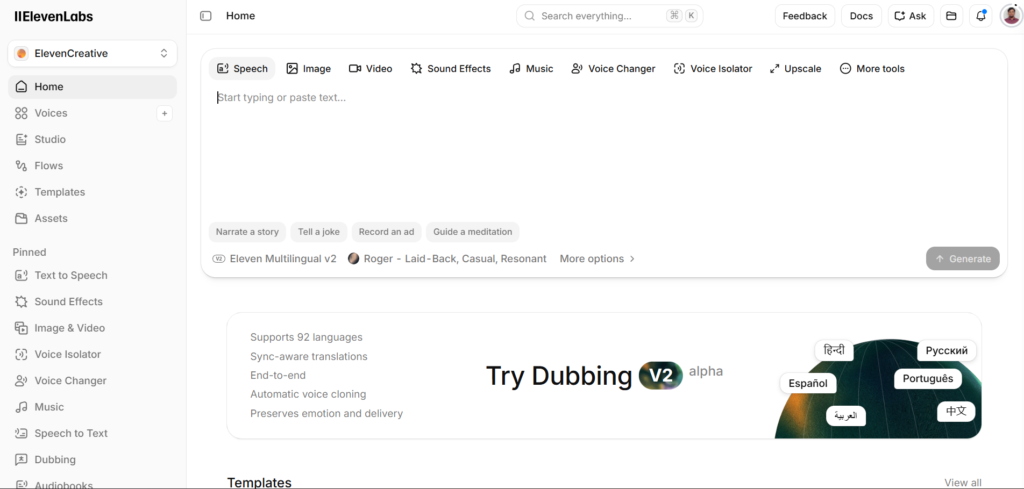
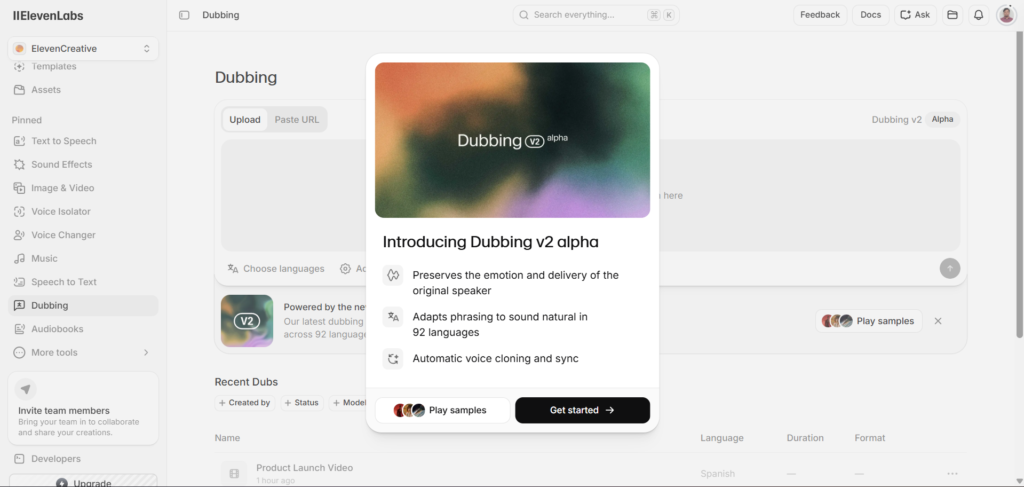
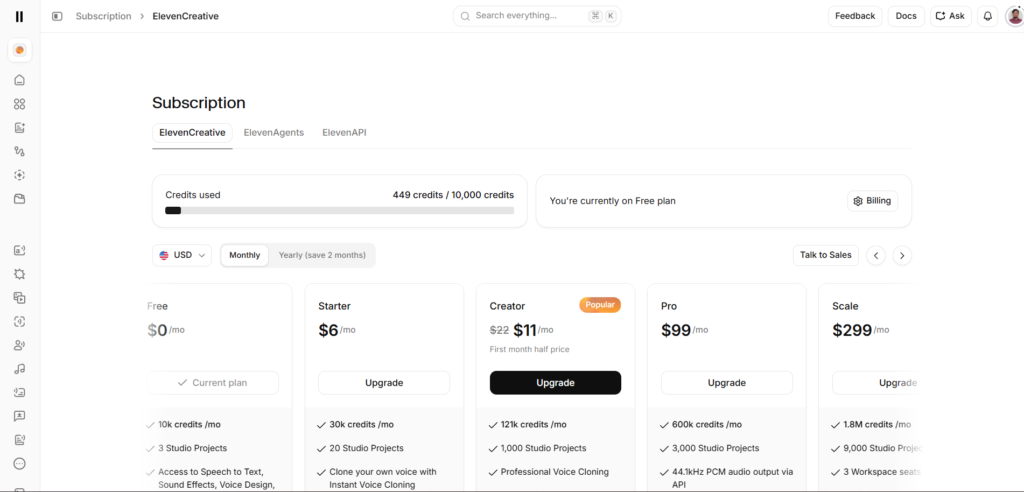
ElevenLabs dubbing, delivered through what the company calls the Dubbing Studio, automatically translates and re-voices video or audio content into a different language, preserving the timing and, when paired with voice cloning, the original speaker’s actual vocal character rather than replacing it with a generic voice actor. This is unlocked starting on the Creator plan, making it one of the specific features that pushes many serious content creators past the entry-level Starter tier.
The technology combines several distinct AI capabilities working together: automatic transcription of the source audio, translation into the target language, and voice generation that attempts to match the timing of the original speech closely enough that the dubbed audio feels reasonably synchronized with the original video’s visuals and pacing. This is a meaningfully harder technical problem than straightforward text-to-speech, since dubbing needs to respect timing constraints that free-form narration does not.
For a full understanding of how dubbing fits within ElevenLabs’ broader product lineup, our ElevenLabs Review 2026: 9 Honest Truths About the AI Voice Tool Everyone’s Cloning covers the complete platform, since dubbing represents just one part of a much larger set of voice and audio tools built around the same underlying technology.
Why Dubbing Used to Be Out of Reach for Most Creators?
Traditional professional dubbing has historically been reserved for well-funded productions, major film studios, large streaming platforms, and established media companies with dedicated localization budgets. The process required booking studio time in each target market, hiring fluent voice actors, coordinating translation review for cultural accuracy, and running a full quality assurance pass before a localized version was considered release-ready.
This cost and coordination barrier meant most independent creators, small businesses, and educational content producers simply never pursued multilingual versions of their content at all, regardless of how much international audience demand might have existed. Automated dubbing tools have fundamentally changed this calculation, not by matching traditional studio quality in every case, but by making a reasonably strong first version accessible at a cost and timeline that was previously unimaginable for smaller creators.
How ElevenLabs Dubbing Actually Works?
Understanding the specific technical steps involved in automated dubbing helps set realistic expectations for output quality across different types of source content.
Transcription and Translation
The process begins with automatic transcription of the source language audio, followed by translation into the target language. Translation quality varies somewhat depending on the specific language pair involved, with more widely spoken language pairs generally producing more reliable, natural-sounding translations than less common pairings where less training data exists for the underlying translation model.
Timing and Synchronization
Once translated, the system generates speech in the target language while attempting to match the pacing and timing of the original source audio closely enough to maintain reasonable synchronization with the video’s visuals. This is genuinely difficult, since different languages naturally require different amounts of time to express the same underlying meaning, meaning a direct translation, spoken at a natural pace, often runs either shorter or longer than the original source audio’s timing.
Voice Preservation Through Cloning
When paired with voice cloning, dubbing can preserve the original speaker’s actual vocal character across the translated version, rather than replacing their voice entirely with a generic, unrelated voice. This combination, translation plus voice cloning, is specifically what allows a creator’s dubbed content to still sound recognizably like them, just speaking a different language, which meaningfully differs from traditional dubbing where a completely different voice actor performs the localized version.
Quality Varies by Content Type
Straightforward, clearly spoken content, like a single narrator explaining a concept directly to camera, generally dubs more reliably than content with overlapping dialogue, heavy background noise, or rapid, emotionally varied delivery. Creators working with more complex source audio should expect to spend more time reviewing and manually correcting the automated output compared to simpler, single-speaker narration content.
Content involving specialized terminology, industry jargon, or heavy cultural specificity, idioms, regional references, or wordplay that does not translate literally, also tends to require more careful human review than general, plainly stated informational content. Automated translation continues improving at handling these edge cases, but creators working in specialized fields should build review time into their workflow rather than assuming universal translation accuracy across every possible subject matter.
Step-by-Step Guide to Dubbing a Video With ElevenLabs
Here is a practical workflow for actually producing a usable dubbed version of your content rather than expecting a single-click perfect result.
Step 1: Confirm Your Plan Includes Dubbing Studio Access
The Dubbing Studio requires at least the Creator plan, so confirm your current subscription tier before attempting to use this specific feature, since it is not available on Starter or the free plan.
Step 2: Prepare Clean Source Audio Before Uploading
Reduce background noise and ensure clear, well-separated speech in your source video before uploading for dubbing, since cleaner source audio produces meaningfully more accurate transcription and, by extension, more accurate translation and dubbed output.
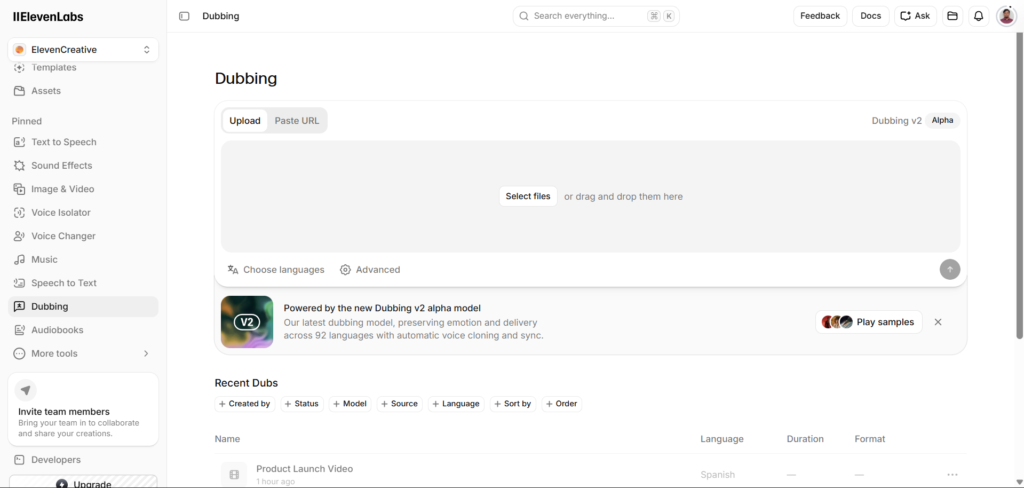
Step 3: Upload Your Video and Select Target Languages
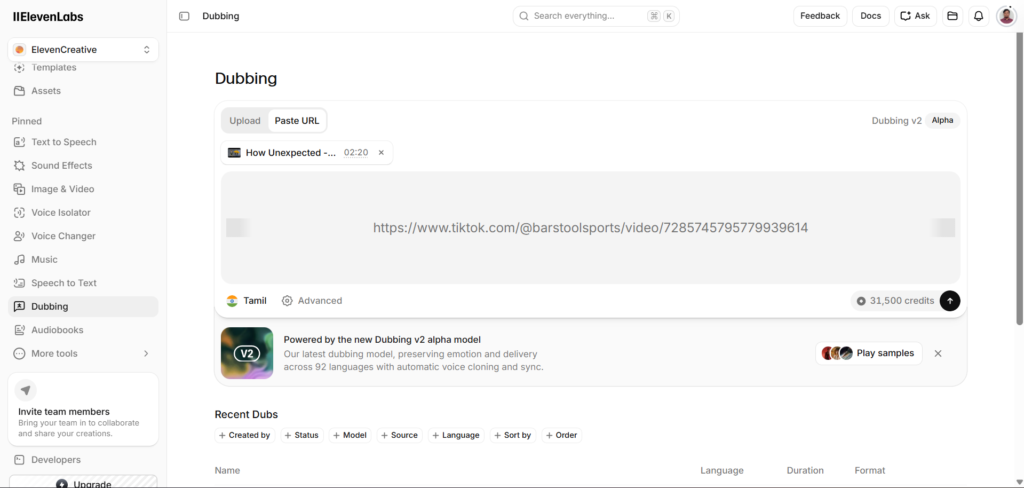
Upload your source video and select the specific target language or languages you want to generate dubbed versions for, keeping in mind that quality can vary somewhat between different language pairs based on translation model strength.
Step 4: Review the Automated Transcription for Accuracy First
Before proceeding to translation and voice generation, review the automated transcription of your source audio for accuracy, correcting any errors at this stage rather than letting a transcription mistake propagate through translation and final voice generation.
Step 5: Enable Voice Cloning for Speaker Consistency
If preserving your own or a specific speaker’s vocal character across the dubbed version matters for your content, enable the voice cloning option rather than defaulting to a generic voice for the translated audio.
Step 6: Review the Dubbed Output Against the Original Video
Watch the finished dubbed version alongside the original, paying specific attention to timing synchronization and any awkward pacing that might need manual adjustment before publishing.
Step 7: Manually Correct Any Problem Sections
For sections where automated timing or translation quality falls short, particularly around idioms, cultural references, or specific technical terminology that may not translate cleanly, manually correct the specific problem section rather than accepting a flawed automated pass across the entire video.
Key Benefits of ElevenLabs Dubbing
The cost reduction compared to traditional dubbing is substantial and represents the most immediately obvious benefit. Traditional professional dubbing requires hiring voice actors fluent in each target language, booking studio time, and coordinating a full production and quality review process, costs that quickly become prohibitive for individual creators or smaller content operations working across multiple target languages.
Speed matters significantly for creators wanting to release localized versions close to their original content’s publish date rather than weeks or months later once traditional dubbing logistics are complete. Automated dubbing can produce a usable draft within hours rather than the weeks a traditional localization pipeline typically requires.
Voice preservation through cloning offers something traditional dubbing genuinely cannot replicate at any reasonable cost, the actual original speaker’s vocal character carrying across every language version of their content, maintaining a consistent creator identity across a genuinely global audience rather than sounding like an entirely different person in each market.
Accessibility for smaller creators and businesses represents a meaningful shift in who can realistically pursue international audience growth. Multilingual content used to be practically limited to well-funded productions with dedicated localization budgets, while automated dubbing makes at least a reasonable first version of multilingual content accessible to creators operating at a much smaller scale.
Comparison Table
| Tool Name | Voice Preservation | Timing Accuracy | Language Pair Coverage | Monthly Cost |
|---|---|---|---|---|
| ElevenLabs Dubbing Studio | Yes, via voice cloning | Good, automated sync | Broad, varies by pair | Free tier limited, Creator $22+ |
| Rask AI | Yes, via voice cloning | Good | Broad | Free tier limited, paid from ~$25 |
| HeyGen | Yes, with video lip-sync | Very good, lip-synced | Broad | Free tier limited, paid from ~$29 |
| Papercup | Limited | Good, human-reviewed option | Curated set | Custom, enterprise-focused |
| Traditional Studio Dubbing | No, different voice actor | Excellent, human-timed | Any, with right talent | Highly variable, often $500+/minute |
Pricing reflects publicly listed rates as of mid-2026. Video-specific competitors like HeyGen additionally offer lip-sync adjustment, matching mouth movements to the dubbed audio, a capability ElevenLabs’ dubbing focuses less heavily on compared to its core voice preservation and translation accuracy strengths.
Who ElevenLabs Dubbing Actually Works Best For?
Content creators with an established audience in one language looking to expand into new international markets get the clearest, most direct benefit, particularly when paired with voice cloning to maintain their recognizable vocal identity across every new language version.
Educational content creators and course producers benefit significantly from dubbing’s ability to make existing content accessible to non-native speakers without needing to record entirely separate versions of every lesson, a meaningful barrier reduction for anyone building an international audience for structured educational content, a use case that pairs naturally with the workflow habits covered in our guide on ElevenLabs for YouTubers 2026: 8 Proven Ways to Sound Like a Pro Without a Mic.
Small businesses and marketing teams producing product or training videos for multiple international markets benefit from a meaningfully lower cost path to localized content compared to traditional dubbing, even accounting for the manual review and correction time a properly quality-checked automated dub still requires.
Creators or businesses requiring frame-perfect lip-sync accuracy, particularly for content where mouth movement mismatch would be highly noticeable or unacceptable, should evaluate video-specific alternatives offering dedicated lip-sync adjustment alongside voice dubbing, since this remains a more specialized capability than ElevenLabs’ core dubbing focus currently provides.
FAQ
How accurate is ElevenLabs automated dubbing?
Accuracy varies meaningfully by content type and language pair, with clear, single-speaker narration in widely spoken language pairs generally producing the most reliable results. Content with overlapping dialogue, heavy background noise, or less common language pairings typically requires more manual review and correction before the dubbed output is genuinely publish-ready. Most creators treat the automated output as a strong first draft requiring targeted review rather than an immediately perfect, publish-ready final product across every type of source content.
Can ElevenLabs dubbing preserve my own voice in other languages?
Yes, when paired with voice cloning, ElevenLabs dubbing can preserve a speaker’s original vocal character across the translated, dubbed version, rather than replacing it with a generic voice actor’s voice. This is one of the platform’s more distinctive capabilities compared to traditional dubbing, where a completely different voice actor typically performs each localized language version, meaning the original speaker’s actual voice character is lost entirely in the traditional approach.
Does ElevenLabs dubbing sync lip movements to the translated audio?
No, ElevenLabs’ dubbing focuses primarily on translation accuracy and timing synchronization at the audio level rather than adjusting the video’s visual lip movements to match the new dubbed audio. Some competing tools specifically offer this additional lip-sync capability, which matters more for certain content types, close-up interview footage, for example, where mouth movement mismatch is highly noticeable, than for content like voiceover-driven explainer videos where the speaker’s face may not even be prominently visible throughout.
Which languages does ElevenLabs dubbing support?
ElevenLabs supports dubbing across a broad range of languages, though translation and voice quality can vary somewhat between specific language pairs depending on how much training data exists for that particular combination. Widely spoken language pairs, such as English to Spanish or English to Mandarin, generally produce more reliable results than less common pairings. Checking current official documentation for the specific language pair relevant to your project is worth doing before committing significant content to a less commonly requested language combination.
Is ElevenLabs dubbing cheaper than hiring a professional dubbing studio?
Yes, dramatically so for most individual creators and smaller businesses. Traditional professional dubbing, involving hiring voice actors fluent in each target language and booking dedicated studio time, can cost hundreds of dollars per minute of finished content, while ElevenLabs’ dubbing is included within a standard Creator plan subscription starting around $22 monthly. This cost difference is precisely why automated dubbing has made multilingual content genuinely accessible to creators who previously could never have justified traditional professional localization costs.
Do I need to manually edit ElevenLabs dubbed content before publishing?
Most experienced users do at least some manual review and correction before publishing, particularly around idioms, cultural references, or technical terminology that may not translate cleanly through fully automated translation. Treating the automated dubbing output as a strong first draft requiring targeted review, rather than an immediately publish-ready final product, tends to produce noticeably better results than publishing the raw automated output completely unreviewed.
Final Thoughts
ElevenLabs dubbing has genuinely changed the economics of multilingual content production, making a capability that used to require significant budget and coordination accessible to individual creators and smaller businesses working with a standard monthly subscription instead. The combination of translation, timing synchronization, and voice cloning together represents real, useful technical achievement rather than a single flashy feature.
The technology is not yet a complete replacement for professional studio dubbing in every context, particularly for content requiring frame-perfect lip-sync accuracy or handling especially complex, overlapping dialogue. Treating automated dubbing as a strong, cost-effective first draft that still benefits from targeted human review remains the most reliable approach for anyone genuinely relying on dubbed content to represent their work well in a new market.
As translation and voice generation quality continues improving, expect the gap between automated and traditional studio dubbing to keep narrowing, particularly for widely spoken language pairs where the underlying models have the most training data to draw from. Less common language pairs will likely continue to require more manual review for the foreseeable future, simply due to the relative scarcity of high-quality training data available for those specific combinations.
Test the Dubbing Studio on a shorter piece of your actual content first, reviewing the output carefully against your specific quality standards, before committing your full content library to an automated multilingual expansion strategy.
External Links: